Q&A with W. Tod Newman, Author of The Halls of the Shadow King
Being a full-time author means dealing with a strange paradox.
No one outside your immediate circle will ever read your book without marketing. For introverted authors who loathe self-promotion, this stinks. But I’ve accepted it as necessary. Most of us write because we believe we’re offering something valuable—entertainment, wisdom gleaned from experience, or both. That value disappears if we never reach the right readers.
I’ve also learned that there are sadistic people out there who find great satisfaction in tearing down authors through anonymous one-star reviews. Often these come from individuals who never bought or read the book. I’ve heard stories of authors receiving one-star reviews describing entirely different books from the one they wrote. Amazon rarely removes these unless they’re extreme violations. They’ll tell you it averages out eventually.
Getting actual readers to leave reviews? Nearly impossible. Whole industries exist around “review farming” to manufacture early buzz for new releases. I find this distasteful.
So here’s my attempt at a different approach—a Q&A based on questions people have actually asked me. Maybe some stray Google search will bring an interested reader this way. Stranger things have happened.
Question: How did you come up with the idea for The Halls of the Shadow King series?
Most authors writing Young Adult series don’t start with AD 280 in the Roman Empire. This choice reflects my love of research—after writing two novels set during the Old Testament prophets, diving into this era was easy and enjoyable.
But the idea came as a question: “What would have happened if the powerful gifts seen in the early church had manifested during Roman persecution?” The timing seemed obvious. Emperor Valerian launched unusually harsh persecutions that began suddenly and ended just as suddenly under his son. My research never turned up a compelling reason why.
Amal emerged as the answer to that question—a gifted young man drawn from street crime in Damascus into a secretive organization dedicated to furthering The Way. His gift combines elements I’ve seen scattered through legends worldwide. Why not place a character who can reshape reality at the center of world-changing events?
Question: Is Amal a perfectly powerful character like Superman?
I struggled to keep Amal human. I don’t enjoy all-powerful, all-good characters in literature. Besides his extraordinary gift, I gave Amal something perhaps more valuable: humility.
Where did this come from? Partly from the kindness of his Creator, but also from making mistakes and learning his capacity for error. He never feels fully confident to me, which makes him real.
If anyone actually reads this and engages, I’ll keep writing these Q&A pieces until people get sick of it!
Want to Check out the SERIES? Head over to my store (product is fulfilled from Lulu.com, which makes a nicer paperback product than Amazon).
Question: Why do you love writing so much?
I’ve asked myself this since high school. Writing was something I kept pushing forward on despite never being satisfied with the output. Eventually I started appreciating my own style and discovered that I could finally complete works I’d started and abandoned. The Halls of the Shadow King is an example—I wrote about half of it between 2016 and 2018, then let it rest. After publishing my two Old Testament prophet novels in the 2020s, I returned to “Halls” and found I could finally tell Amal’s story the way it needed to be told.
But why do I love it?
I write because I like to share. What I’ve learned and gradually understood about life might be transferable to others. My reading taste has always leaned toward the classics, where authors were less distracted by material things (and iPhones!) and more focused on sharing their wisdom, their hearts, and their imaginations.
I think readers may detect this influence in my writing. I hope it has a good effect.
Here are a few of the professional reviews I’ve received on the first book in the series. I’m not really obsessed with reviews or marketing my books, but I won this review package in a Independent Book Contest and figured I ought to repost. They were all 5-star reviews… Readers’ Favorite does seem to give a fair number of 5-star reviews, but it’s hard to know the percentage since they don’t post anything lower than 4-star. Still, maybe good?
The Halls of the Shadow King: The Apprentice by W. Tod Newman follows Amal, an orphaned street thief in third-century Syria, fighting to keep his younger sister Neffie alive in a harsh and unforgiving world. When slave traders take her, he discovers a remarkable ability to reshape reality, altering outcomes and alliances in ways others cannot. His daring rescue of dozens of enslaved children draws the attention of the Shadow King, who leads a network safeguarding followers of The Way across the Roman Empire. As Emperor Valerian intensifies the persecution of bishops and believers, Amal is tasked with infiltrating Rome and influencing the emperor. Guided by sages and strategists, he must master his powers while confronting ancient, formidable forces that threaten the empire and the survival of The Way. “That is the balance we all must find – between power and restraint, between action and wisdom. Today you learned more about both than a hundred lessons could have taught you.”
The Halls of the Shadow King: The Apprentice by W. Tod Newman is a really ambitious undertaking, but the author handles it well. I love the contrast of scale, authority, and vulnerability. Amal and Neffie are small children entering spaces filled with political and mystical authority, and we quickly learn that Amal, as a seemingly powerless protagonist, is about to navigate a complex, threatening world. The world-building itself is phenomenal. Newman constructs a richly layered world with cultural, historical, and mystical dimensions. References to both tangible and legendary histories suggest that Amal’s experiences are part of a broader continuum. The inclusion of diverse locations and scholarly networks, like the Alexandrian manuscripts and the Wanderer’s travels, anchoring these elements in a historical context, got me wondering how, through Amal, visions and altering events will shape future outcomes. Overall, this is a solid first entry into the new series, and I look forward to seeing what comes next.
Reviewed by Makeda Cummings for Readers’ Favorite
Amal, a young street orphan and thief, begins life under the cruel hand of the Roman Empire. His existence is one where Christians face persecution and slavery. When his sister, Neffie, falls prey to slave traders, Amal sets out on a harrowing quest to save her. Along the way, strange supernatural powers begin to stir inside of him when the dangers close in. Gradually, Amal’s journey draws him deeper along a secret path called The Way. Ultimately, he is guided by an enigmatic spiritual leader called the Shadow King. Soon enough, he meets friends and foes who force him to value the power of trust while embracing his true purpose. With time running short, Amal stands between light and darkness. Will his inner strength guide him toward freedom or plunge him deeper into the shadows? Find out in W. Tod Newman’s The Halls of the Shadow King.
This captivating novel is more than your average YA historical fantasy. It is a story about inner turmoil and resilience. Set against the backdrop of Roman persecution, W. Tod Newman passionately writes about how ordinary people can find extraordinary strength to do brave things when faced with oppression and suffering. Through Amal’s eyes, readers will bear witness to how spirituality, power, and self-identity can clash in a world dictated by secrets and hidden threats. I’m genuinely amazed at how well the story merges real history and magical elements, making Amal’s encounters both believable and exciting to follow. The author knows how to create characters that come alive and stand out throughout the book. Each character, from the Shadow King to Amal and Gallien, conveys different ways people respond to issues like fear and control. From beginning to end, The Halls of the Shadow King challenges readers to think about the price of truth and what it means to withstand internal and external darkness. It truly is a literary gem.
Reviewed by Isabella Harris for Readers’ Favorite
The Apprentice by W. Tod Newman is the first installment in The Halls of the Shadow King series. Set during the Roman era, Amal, a young street thief, is searching for his sister, whom he believes has been kidnapped by slavers. During his search, he is overwhelmed by an extraordinary power that grants him the ability to reshape reality. He uses this power to successfully rescue his sister, with other children held hostage by the slavers, leading them to seek refuge in a community of worshippers called The Way. Unfortunately, the followers of The Way Amal are being threatened by the Roman Empire, which strongly opposes their beliefs. With Amal’s newfound powers, the fate of their beliefs now rests on his ability to understand and harness his extraordinary gift.
I was really impressed by how W. Tod Newman was able to blend a historical setting with faith and mysteries. The Halls of the Shadow King shows the reign of the Roman Empire and the struggle the followers of The Way suffered at the hands of the Romans. I loved how remarkably the characters were developed, especially Amal, who goes from a young street thief to someone on whose shoulders the fate of an entire religion lies. The pacing kept me engaged, which allowed me to fully understand Amal’s motivations and his journey of fully harnessing his powers. The Halls of the Shadow King: The Apprentice covers themes of humility, determination, greed, deceit, and much more. I recommend it to readers who are interested in historical fiction with a touch of extraordinary mystery.
Looking for a historical fiction dragon book that breaks all the fantasy tropes? You’ve found it.
After three books of supernatural intrigue spanning from Damascus to Rome, The Halls of the Shadow King series is taking an unexpected turn—straight into the mist-shrouded mountains of ancient Britannia.
And this time, Amal faces something he can’t simply outsmart or outmaneuver: a dragon.
From Street Thief to Dragon-Binder
When we first met Amal in The Apprentice, he was a desperate thirteen-year-old stealing maps to save his sister. Now, as the Shadow King leading a vast underground network across the Roman Empire, he’s being called to confront an ancient evil that has terrorized British villages for generations.
But here’s the twist: he might not be able to kill it.
This isn’t your typical historical fiction dragon book where the hero simply slays the beast and rides off into the sunset. In fact, Amal’s mission is far more complex—and far more dangerous.
What Readers Are Saying About This Historical Fiction Dragon Book
“I thought this was historical fiction with a supernatural edge. Book Four turned it into something entirely different—and I couldn’t put it down.”
The fourth installment, Brittania Calls, takes everything that made the first three books compelling—the intricate plotting, the richly researched historical detail, the exploration of power and humility—and adds something readers will love: a dragon.
But not the dragon you expect.
The Mission: Binding an Ancient Evil
When three young Britons arrive at Amal’s safehouse in Malta with desperate pleas for help, he learns that the persecution-free awakening spreading across Britannia is threatened by something older than Rome itself. A dragon, dormant for decades, is stirring in the western mountains. Moreover, if The Morrigan—the ancient entity Amal barely survived in Rome—is behind its awakening, the consequences could reshape the entire empire.
Amal’s solution? Assemble a team unlike any other:
Finn, the Irish warrior-prince with knowledge of Celtic magic
Andreas, the scholarly priest with expertise in ancient texts
Four Carthaginian practitioners experienced in binding rituals
Three desperate British youths carrying fragments of forgotten druid wisdom
Their goal isn’t to slay the dragon in some heroic confrontation. Instead, it’s to bind it—seal it away using ancient rituals that combine Carthaginian, Hebrew, and Celtic traditions into something entirely new.
Why This Historical Fiction Dragon Book Hits Different
Historical readers will love the meticulous research into 3rd-century trade routes from Carthage to Britain, the authentic portrayal of early Christian communities, and the seamless blend of Roman, Celtic, and North African cultures.
Fantasy readers will devour the dragon lore, the exploration of binding rituals versus destruction, and the way ancient spiritual entities interact with the physical world.
Literary fiction fans will appreciate the deeper questions: What does victory look like when you can’t simply destroy your enemy? How do you wield supernatural power with humility? What happens when your faith requires you to walk into situations where success isn’t guaranteed?
Historical Accuracy Meets Celtic Magic
What sets this early Christian fiction apart is the exhaustive research behind every detail. The trade goods carried from Carthage to Britannia? Historically accurate—wine, olive oil, grain, and garum (fermented fish sauce) were staples of Roman-era commerce. The Atlantic crossing through the Pillars of Hercules? Based on actual Carthaginian trade routes that predated Roman dominance.
However, the magic system isn’t borrowed from modern fantasy. The binding rituals draw from genuine ancient traditions—Carthaginian texts on containing spiritual entities, Hebrew practices of spiritual warfare, and Celtic druid wisdom that survived Rome’s suppression of their culture.
A Three-Week Voyage Into Darkness
The Atlantic crossing alone is worth the price of admission. As Amal’s team sails from Carthage through the Pillars of Hercules into the wild Atlantic, they’re not just traveling to Britain—they’re preparing for spiritual warfare unlike anything they’ve faced before.
They study ancient texts on binding rituals. They train in coordinated combat tactics. They listen as the young British woman Branwen sings songs her grandmother taught her—songs that contain fragments of the original ritual that once sealed the dragon away.
And slowly, they transform from a group of individuals into something more powerful: a unified force capable of confronting ancient evil.
Behind the Scenes: Researching the Dragon
Creating a believable historical fiction dragon book required diving deep into multiple mythological traditions. Celtic dragon lore differs significantly from Greek or Norse traditions. The ancient Britons viewed dragons not as mindless beasts but as intelligent, potentially corruptible beings—guardians who could be twisted into monsters.
This research led to one of the book’s central questions: What if the dragon wasn’t always evil? What if ancient kings made pacts with it, offering worship in exchange for protection? And what happens when such a creature, corrupted over centuries, can no longer be reasoned with?
The Questions Readers Are Asking
Q: Do I need to read Books 1, 2, and 3 first?
While Brittania Calls can stand alone, the full impact of Amal’s journey—from street thief to apprentice to Shadow King—is best experienced from the beginning. Plus, his confrontation with The Morrigan in Rome sets up crucial context for the Britannia mission.
Q: Is this Christian fiction?
It’s historical fiction set in the 3rd-century church during Roman persecution. The characters are believers navigating how to use supernatural gifts faithfully. But it’s written for a broad audience—anyone who loves well-researched historical fiction with supernatural elements.
Q: Does the dragon get killed?
No spoilers! But I will say this: the resolution challenges typical fantasy tropes in ways readers are finding surprisingly satisfying. This spiritual warfare fiction takes a different approach to victory.
Q: How accurate is the Roman Britain setting?
Extremely. From the garrison locations to the trade networks to the tension between Romanized Britons and unconquered tribes beyond the Wall—every detail is grounded in historical research. Even the dragon’s lair placement is based on actual Celtic sacred sites in western Britain.
Q: When does the book release?
Brittania Calls is coming soon! Meanwhile, check out the full series (Kindle or Paperback) on Amazon HERE. At Desdichado Books, we attempt to keep the prices as low as possible to prevent any barrier to potential readers.
Power wielded with humility rather than domination
Communities working together rather than lone heroes
Spiritual warfare that acknowledges some battles are about containment, not conquest
Historical accuracy that brings the 3rd-century Mediterranean world to vivid life
Deep questions about faith, calling, and what it means to serve something greater than yourself
Multi-cultural perspectives blending Roman, Celtic, Carthaginian, and Hebrew traditions
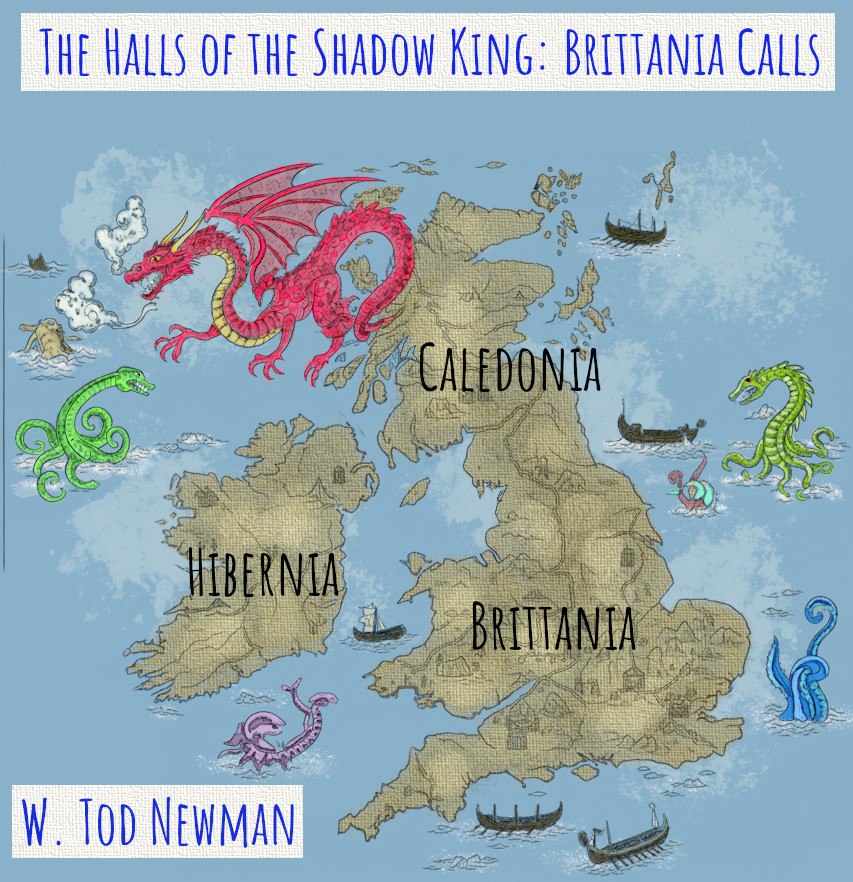
A Map of Amal’s Journey to Britannia
The team’s route takes them through some of the most strategic locations in the ancient Mediterranean:
Antioch – Network headquarters where the mission begins
Cyprus – First gathering point for intelligence
Rhodes – Strategic maritime crossroads
Crete – Where they survive a devastating storm
Carthage – Where they recruit the binding specialists
Through the Pillars of Hercules – Entering the wild Atlantic
Western Britannia – The dragon’s domain
Each stop adds crucial pieces to the puzzle—knowledge, resources, and team members who will prove essential in confronting the dragon.
The Author’s Vision
W. Tod Newman set out to write a different kind of early Christian fiction—one that didn’t shy away from supernatural elements but grounded them in historical reality. The result is a series that appeals to fans of Bernard Cornwell’s historical accuracy, Stephen Lawhead’s Celtic spirituality, and Frank Peretti’s spiritual warfare—but with its own unique voice.
“I wanted to explore what would happen if someone with genuine supernatural gifting lived during the Roman persecution. Not a sanitized, safe version—but the real questions: How do you use such power faithfully? What does it cost? And what happens when simply ‘winning’ isn’t the point?” – W. Tod Newman
Ready to Join the Voyage?
If you’re tired of the same old fantasy tropes… if you love historical fiction that doesn’t sacrifice accuracy for drama… if you want characters who wrestle with real questions about power, faith, and purpose… then this is your series.
Start with The Apprentice and watch a street thief become something extraordinary. Continue with Into Deeper Waters as the stakes expand from one city to an empire. Proceed to The Hidden Order which is the conclusion of the first three novels and explores conflict with ancient evil powers and saving the soul of Rome.
Then Finish with Brittania Calls as Amal faces his greatest challenge yet in the misty mountains of Britannia.
Because sometimes the most powerful victories don’t come from destroying your enemies.
Sometimes they come from learning to bind them—and trust that the Great King’s purposes will ultimately prevail.
Available Now at All Major Retailers
The Halls of the Shadow King series by W. Tod Newman Published by Desdichado Books
“Newman has crafted something rare—a historical fiction dragon book that respects both history and faith while delivering edge-of-your-seat supernatural thriller pacing. The Britannia storyline is his best work yet.”
Tags: historical fiction dragon book, early Christian fiction, Roman Britain fantasy, spiritual warfare fiction, Celtic magic historical novel, 3rd century Rome, Carthage to Britain, dragon binding ritual, The Halls of the Shadow King
I enjoyed creating my short post the other day about the “in-process” cover art for my latest book, so I decided to break down how I layer my cover art and how I proceed from line art all the way to finished, filtered images. Plus, it gives me a nice break from writing.
First, the tools I use are pretty much 1) pencil and paper (and pen), 2) A scanner, and 3) GIMP (open source photo editing tool). I’ve been using GIMP for aeons now and have some pretty comfortable rituals to build up images layer by layer.
First: The Line Art
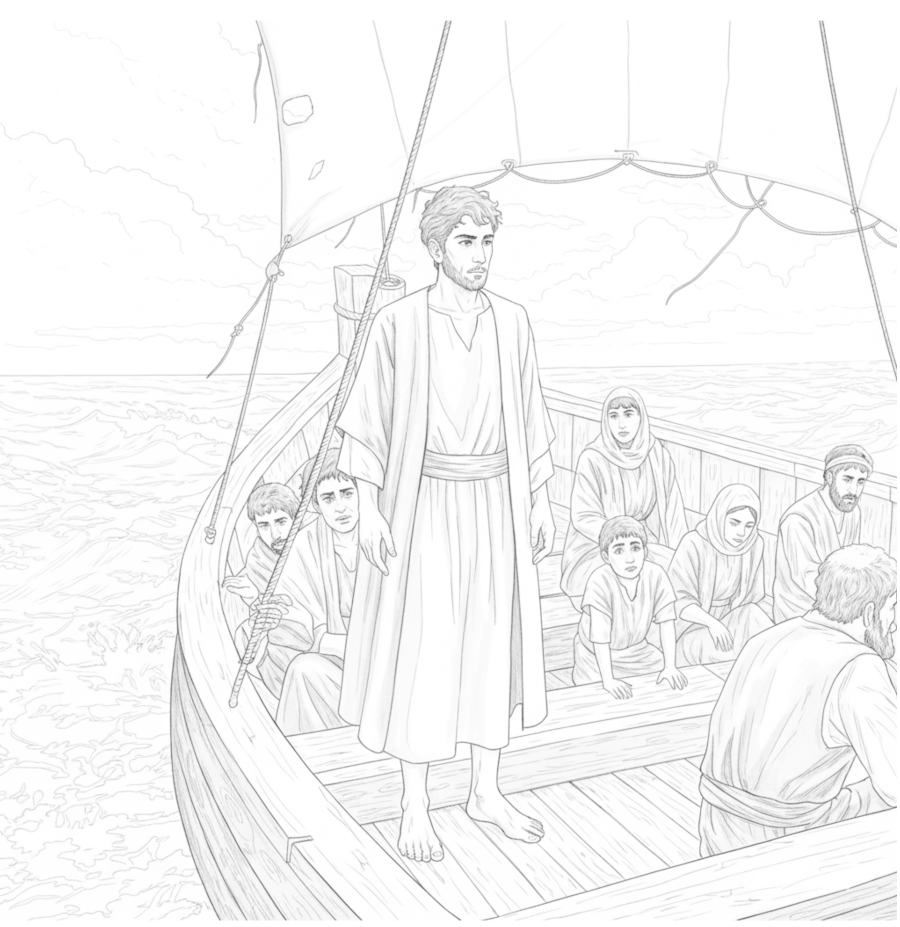
When I’m working on a book, I usually will sketch up 2 or 3 ideas that correspond with something “key” in the book. In the case of this image, from “The Halls of the Shadow King: Into Deeper Waters”, there is significant sea travel from Rome down the eastern coast of Africa. Lots of time in the water. So I came up with some drafts that showed my main character (a little older than he was in the first book) with people from a supporting village in the Kingdom of Aksum (present day Ethiopia). Once I have a sketch I like, I ink it in with fine tip sharpie then scan it into the computer. An important step comes next as I open it in GIMP (usually inside a book cover template where I paste it as a layer). I select the line art layer, go to the “Layer” pull-down, then “Transparency”, then “Color to Alpha”. What I’m trying to do is remove all of the white and leave just the black line art. That way, layers below the line art show up through–but not over–it. Then I play with darkening, thickening, etc., the line art to get it the way I like. At that point, it looks like this (shown with a plain white background behind the line art so you can see it).
Line Art for “Into Deeper Waters” – Tod Newman, 2024
Note that I like to leave some of the pencil in as greyscale, whereas the darker lines are penned in by the sharpie. I also tend to leave something like the squiggles for the ocean waves in pencil. Eventually I’ll fill these in with GIMP, sometimes using brushes that specialize in waves. Often I erase the line art in a place like the background if I feel like it is distracting, but I almost always leave it for the foreground characters, the ship in this case, etc.
Next: Background Layer
Generally, the next thing I do is start modifying a basic white background layer with whatever will be in the back. I make the line art visible and paint on the background layer “through” the line art. In this case, I chose the ocean and the sail as my main background elements. I painted the whole ocean at once for the sake of coherence/continuity of the waves, knowing that the ship layer and the character layers (and the line art) would sit on top of it. Here’s what the first pass at the background looked like.
Background Layer – 2024
As mentioned, I like to use GIMP “foam” brushes that make the foam on top of the waves look good. These brushes are created and open sourced by people all over the web and can be downloaded to your GIMP application. This same approach works for Photoshop too, but since GIMP is free, I’ve always used it. There are cloud GIMP brushes too, but my memory is that I hand drew these in GIMP using my Wacom Tablet and standard GIMP brushes.
Next: Color Layers
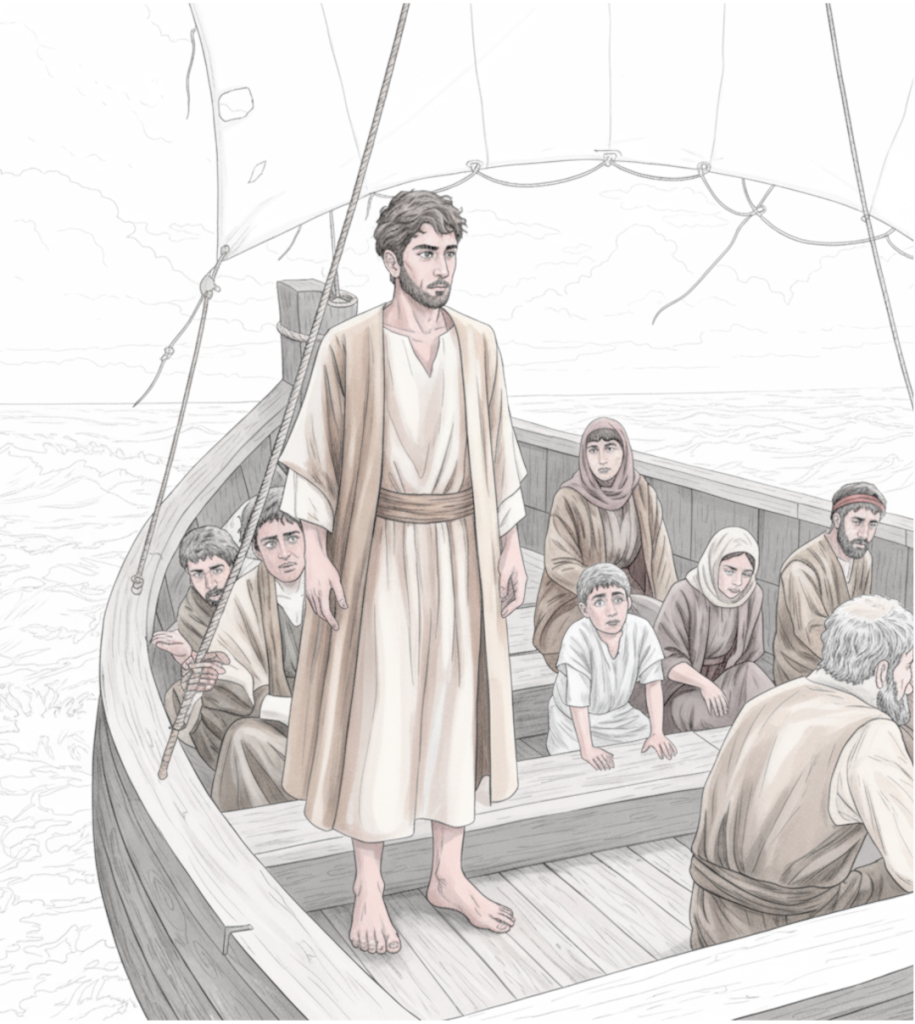
The next thing I typically do is build multiple layers to cover other elements in the image. I have always called these generically “color layers”. I’ll have one color layer for the boat, one for the characters, one for things like birds maybe, etc. These all start as a new “transparent” layer so the layers below show through. Keep in mind that the top layers (the ones you see over everything else) need to be on the top of your layer stack in GIMP (and background is typically the bottom. Here’s an example of an early “Character Color Layer”.
Character Color Layer – 2024
On these layers, I tend to be very sparing with colors and I pick 4-5 colors from one color palate. I find this keeps the drawing from being overwhelming. If I do a bad job here, I can always “cartoonize” the final flattened drawing down to 8 colors or some such.
Finally: Flattened Layer for final edits and Artistic Filters
At some point, I decide which of my 20+ layers are keepers and will become part of the final image. I will show only these layers and build a single flattened image (note: I never have Text in my flattened image. That comes later on other layers). This may or may not be a good approach, but I’ve used it for years, with the notion that I’m just doing light touchup on this flattened image. If I mess stuff up, I just hit undo. This layer is very good for fixing color issues (darkening/lightening/exposure/hue/brightness-contrast, etc.). I also use it to do a lot of “sunlight effects”, which are typically really light, low opacity effects trying to accurately capture the lighting of the scene. Once I have the lighting and colors appropriate and I’ve fixed anything about the original layers that is annoying me, I’ll apply various artistic GIMP filters. To be honest, this often helps fix problems with the image that I might not be good enough to fix. One artistic layer that I chose early on for all the books in The Halls of the Shadow King series was “canvas”, which imposes the structure of a canvas on the image and makes it look like a highly-detailed oil painting. See how the flattened/filtered image looks below.
Flattened Image with Canvas (and maybe a couple other) filter applied. -2024
Closing – The Rest of the Book Cover Process
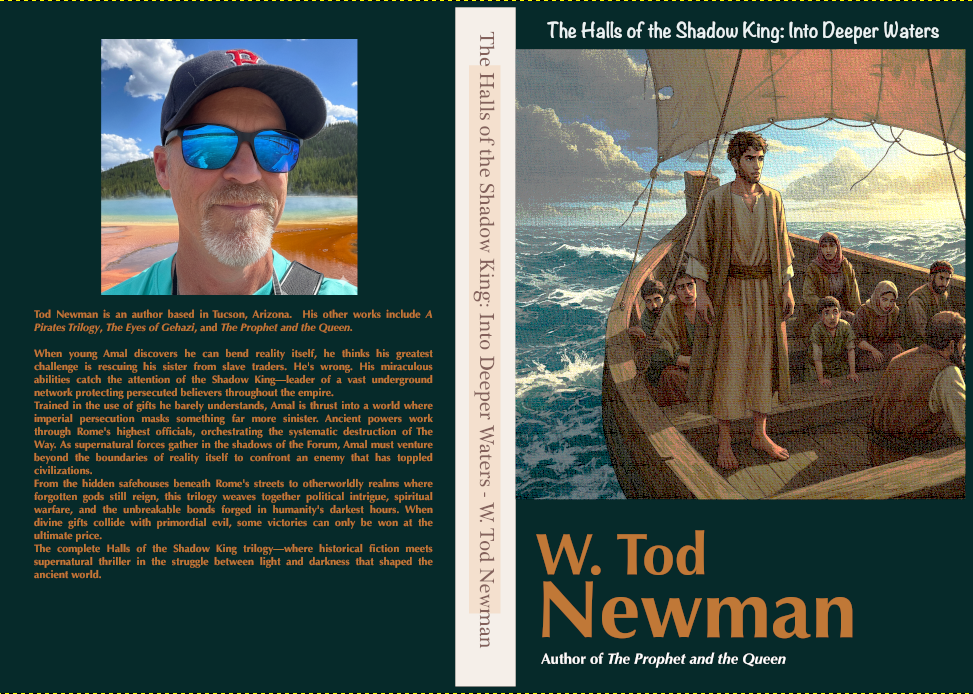
This front cover image becomes the main feature of the whole book cover, but you’re not done yet. I have a template for a 9×6 trade paperback cover that contains the front/back/spine. I then use GIMP to fill in Text on top of everything. Here’s what this looks like for the final book cover copy.
One thing I’ll note too is that this process allows you to do a rev 2 on your cover art if you decide after a year that things need to be refreshed. I did that with book 1 of this series, where I felt after a while that I hated what I did with my main character’s hands (hands are hard for me to draw… lots of sketching and erasing) and thought the art should be lightened. All I had to do was then go in and edit individual layers (line art, character color, background) and make changes, flatten the changes and re-apply filters. Piece of cake!
Recently I published my third “Halls of the Shadow King” novels of the series. However, I didn’t feel like I had finished telling the story of Amal, my main character. So my current project (20K words in as of this moment) is creating a series of novelettes in the 40K word range to explore what happens with Amal.
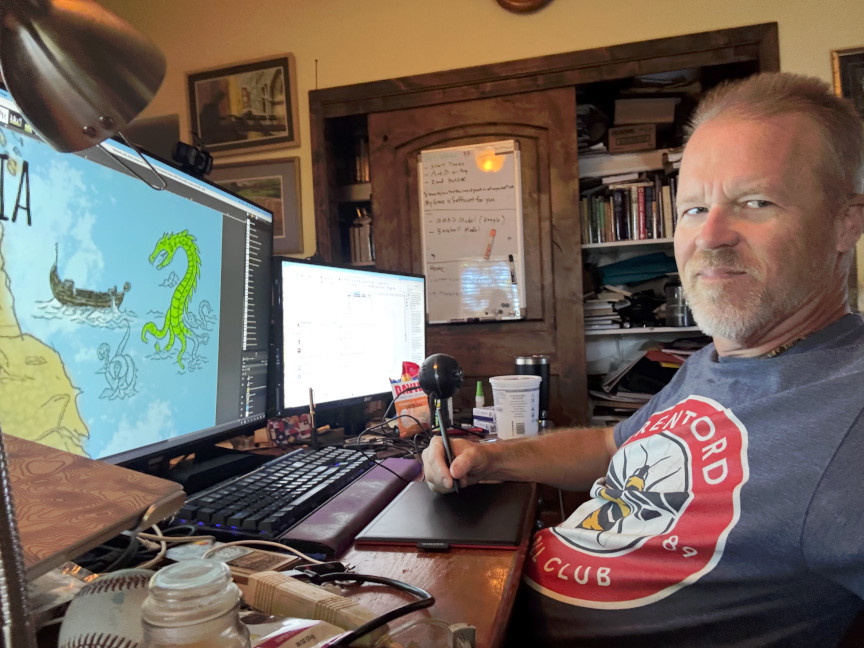
Here I am with my Wacom tablet putting some finishing touches on some sea monsters.
What do you think about the cover so far? As with all my covers, I’m starting with hand-drawn line art which I scan and import into Gimp. I used the Canvas filter on the other three covers, but right now I’m just using it on the Gimp layer which contains the Island colorizations.
Stay tuned. My thinking right now is to only make these novelettes available as Kindle Unlimiteds.
When I began writing The Halls of the Shadow King, I knew I wanted to create something more than another fantasy adventure (maybe it’s “young adult”, maybe not). I wanted to explore a question that has haunted me for years: What if someone with extraordinary supernatural gifts had lived during the height of Roman persecution of early Christianity? What might have happened differently?
Find the full three volume series on Amazon (both Kindle and Paperback) HERE.
The Historical Foundation
The series is set during one of the most turbulent periods in Roman history—the third century AD, specifically during the reign of Emperor Valerian (253-260 AD). This wasn’t a random choice. Valerian launched the first systematic, empire-wide persecution of Christians, targeting not just individual believers but the entire institutional structure of the early church. His edicts were calculated to destroy Christianity by eliminating its leadership, confiscating its property, and forcing apostasy through economic and social pressure.
What fascinated me was how this persecution backfired spectacularly. Instead of destroying the church, it purified and strengthened it. Valerian himself was captured by the Persian king Shapur I and died in captivity—a humiliation that Romans saw as divine judgment. His son Gallienus immediately reversed his father’s policies, ushering in nearly fifty years of peace for Christians.
This historical irony became the backbone of my series. What if divine providence worked not just through miraculous intervention, but through humble individuals gifted with abilities that transcended natural law? A great example of this is the joke about the guy on the roof of his house as floodwaters rise. He holds out for the miracle and ignores multiple rescue attempts. After he is overcome by the flood, he chides God about not performing a miracle as he had hoped and prayed for. God responds, ‘Well, I did send you two boats and a helicopter!” Sometimes we expect and hope for the most dramatic interventions when history is actually made by collections of smaller people using their gifts collectively for good.
The Character of Amal
Amal began as an exploration of power and responsibility. I wanted to create a protagonist whose extraordinary gifts—the ability to perceive and reshape reality itself—came with equally extraordinary moral burdens. Too often in fantasy literature, supernatural power is treated as inherently good or merely a tool to be wielded. I wanted to examine what happens when someone realizes their abilities can change the course of history and yet maintains the facility to remain humble.
The Shadow King organization that Amal eventually leads represents something I found missing in much historical fiction about early Christianity: the sophisticated, international network that actually existed. Early Christians weren’t isolated communities hiding in caves. They were part of a remarkable communication system that spanned the empire, with resources, intelligence networks, and influence that often surprised Roman authorities. Stories of similar entities existed—probably because they were so hoped for—in the Prester John legends. I expanded these stories and fleshed them out to create my Shadow King network.
Historical Research as Creative Fuel
The research phase for this series became an obsession. I spent countless hours diving into the history of the era—trying to understand not just the big political events but how ordinary people lived. What did a third-century residence large enough to be a safehouse actually look like? How did the Roman empire perform road maintenance? How did secret messages travel from Antioch to Rome? What were the daily rhythms of life in a Roman port city? This historical research was greatly entertaining to me and there was no lack of subjects that I needed better knowledge of.
Some of my favorite details came from unexpected places. The hidden canal systems connecting the Red Sea to the Mediterranean that I mention in the series? Those actually existed, though they’re largely forgotten today. The sophisticated cipher systems, the trade networks that doubled as communication channels, the way Christian communities cared intentionally for orphans and sick people—all historically grounded.
I was particularly struck by how little we know about the administrative side of early persecution. The Roman bureaucracy was incredibly sophisticated, but most records of their anti-Christian activities have been lost. This gave me creative space to imagine how such systems might have worked, and how an organization like the Shadow King’s network might have countered them.
Balancing Faith and Fantasy
One of the trickiest aspects of writing this series was handling the supernatural elements authentically. I wanted to create something that would resonate with Christian readers without alienating others, that would respect the historical period without turning into mere religious propaganda. Plus, I want these kinds of devices to appear perfectly natural and accepted by the characters. I have always greatly admired Gabriel Garcia-Marquez’ abilities to create beauty through magical realism.
The solution came through focusing on character-driven questions rather than theological ones. How does someone use extraordinary power humbly? What’s the difference between divine gifting and personal ambition? When is intervention helpful, and when does it interfere with larger purposes? These are human questions that transcend specific religious boundaries.
I also drew heavily on the mystical traditions within Christianity—particularly the Eastern Orthodox concept of theosis (becoming partakers of divine nature) and the rich tradition of Christian mysticism. I also introduced a healthy amount of early Celtic Christianity and even the Ulster Cycle. These provided a theological framework for Amal’s abilities that felt both authentic to the historical period and dramatically compelling.
The Villain’s Journey
Gallien (who becomes Emperor Gallienus in history) presented a fascinating challenge. How do you write a character who starts as a genuine antagonist but is destined to become one of early Christianity’s greatest imperial protectors? The historical Gallienus was a complex figure—a military genius who also issued the first imperial edict granting religious tolerance to Christians. Why did he do this?
I solved this by giving him a character arc that mirrors Amal’s in reverse. Where Amal learns to use supernatural power responsibly, Gallien learns to use earthly power mercifully. Both are mentored by figures who shape their understanding of authority and responsibility, though in very different ways. The differences in training—one with malicious intent; the other with gracious—creates a foil between the two characters.
The presence of Manasseh as Gallien’s dark counselor allowed me to explore how evil often works through seemingly wise guidance. Some of the most chilling scenes in the series come from watching how subtle corruption can be—how someone can be led toward cruelty while believing they’re being rational and strategic. I don’t think I need to mention that this is something we may be noticing in the more “civilized” era we live in.
Hidden Layers and Symbolism
Readers who pay close attention will find layers of meaning woven throughout the series. The Shadow King’s compound, with its architecture drawing from multiple ancient traditions, represents the universal nature of divine wisdom. The stone disk that helps Amal focus his abilities is based on actual archaeological finds from the period.
Even character names carry significance. “Amal” means “hope” in Arabic and Hebrew, while also being a historical name from the period. “Neffie” is derived from “Nephesh,” the Hebrew word for soul or life force. These weren’t random choices—they reflect the deeper themes running through the story and give insight into the characters’ own natures given them from above.
The political intrigue plots mirror actual historical events, though compressed and dramatized. The Persian campaign that ultimately destroys Valerian really happened, and the power struggles within the Roman court are based on documented conflicts.
Why This Story Matters Now
Writing about the third century has given me perspective on our own time. The Roman Empire faced crises that feel remarkably contemporary: economic instability, political polarization, external threats, social transformation. The early Christians navigated these challenges not through political power or military might, but through networks of mutual care, intellectual excellence, and moral courage.
There’s something profoundly relevant about a story where the greatest victories come not from defeating enemies but from transforming them—where power is most effective when wielded with restraint, and where the most important battles are fought not on battlefields but in human hearts.
The Continuing Journey
As I work on new entries into the series, I’m continually amazed by how much the historical research continues to surprise me. New archaeological discoveries keep reshaping our understanding of this period, and I find myself revising scenes to incorporate findings that make the story more authentic. The next wave of “Halls of the Shadow King” stories will probably come in the form of novelettes and I’m targeting Kindle Unlimited releases. As I’ve written before, book marketing is a Crazy-Town, so we’ll see if this approach will bring these stories to new readers.
The Shadow King series has become more than entertainment for me—it’s become a meditation on how ordinary people can serve extraordinary purposes, how power and humility can coexist, and how the most important revolutions often happen quietly, one changed heart at a time.
I hope readers will find in Amal’s journey not just adventure and mystery, but a reminder that we all have roles to play in purposes larger than ourselves—and that sometimes the greatest strength lies in knowing when not to use the power we possess.
The voyage, as I wrote in the first volume, is just beginning.
W. Tod Newman is the author of The Halls of the Shadow King series. He lives in Tucson, Arizona, where he continues researching ancient history and writing about the intersection of faith, power, and human nature.
If you’ve stumbled across this post, chances are you’ve never had to worry about marketing a book. Consider yourself lucky. As someone deep in the trenches, let me share why book marketing feels nearly impossible these days.
The Market Is Absolutely Flooded
The sheer volume of books being published today is staggering. With AI tools becoming more accessible, this flood has only intensified—though I’d argue that AI can’t write a coherent novel yet (time will tell if I’m wrong about this).
A few years back, Amazon was hit with waves of AI-generated books: formulaic, mass-produced novelettes priced at 99 cents each. The problem got so bad that Amazon actually had to limit how many self-published books authors can upload per day. That tells you everything about the scale we’re dealing with.
Predators Are Everywhere
The self-publishing community on Reddit is filled with horror stories about scammers targeting authors. These vultures scan social media for author posts, then swoop in with promises of marketing help or publishing deals. There’s a cynical truth here: the only people consistently making money from books seem to be those selling courses on “how to get rich writing books.”
Here’s a recent post I made about one particular clever scammer, a post which, immediately earned me a fake one-star review on Amazon for my most recent book. Ugh.
Time Is the Ultimate Currency
Unlike a three-minute song that someone might casually stream, a book demands hours of commitment from readers. This creates a massive barrier not just for sales, but for something as basic as getting reviews. In my experience, genuine reviews are rare unless you’re paying for them or calling in favors—which feels like a whole other problem.
Are We Running Out of Readers?
This might be the most troubling question of all. I’ve considered creating audiobook versions of my work, but the costs are prohibitive, and frankly, I don’t have the voice for narration. It makes me wonder: in our shrinking attention span world, how many people are still willing to invest in long-form reading?
Many Authors don’t want to Talk About Themselves
Yes, that’s me for sure. I love writing, world-building, and inserting magic into stories in natural ways. But I hate talking about myself.
I suppose this is mostly me venting into the void, but if any of these points resonate with your experience—or if you think I’m completely off base—I’d love to hear your thoughts.
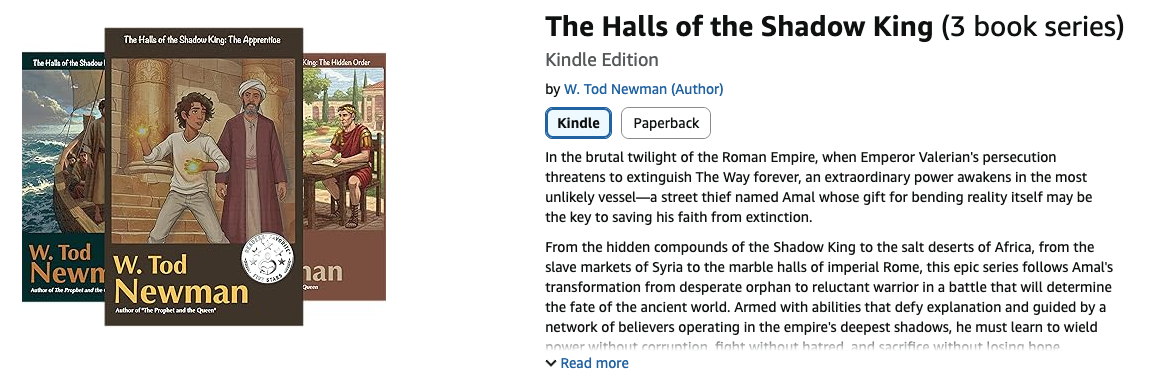
After years (2016-2025) of weaving together supernatural warfare, early Christian history, and political intrigue across three books, I’m thrilled to announce that The Halls of the Shadow King series is now complete and available on Amazon.
What real readers are saying:
“Our culture desperately needs more characters who wield great power with genuine humility. It’s perhaps the rarest combination in literature—and life—yet through faithful effort, it remains possible.”
“Finally, historical fiction that treats faith seriously while delivering genuine adventure and political complexity.”
What Professional Reviewers are Saying:
Here are excerpts from the reviews of Book One, “The Apprentice” from three separate professional reviewers:
“Each character, from the Shadow King to Amal and Gallien, conveys different ways people respond to issues like fear and control. From beginning to end, The Halls of the Shadow King challenges readers to think about the price of truth and what it means to withstand internal and external darkness. It truly is a literary gem.”
“The world-building itself is phenomenal. Newman constructs a richly layered world with cultural, historical, and mystical dimensions. References to both tangible and legendary histories suggest that Amal’s experiences are part of a broader continuum.”
“I was really impressed by how W. Tod Newman was able to blend a historical setting with faith and mysteries… I loved how remarkably the characters were developed, especially Amal, who goes from a young street thief to someone on whose shoulders the fate of an entire religion lies. The pacing kept me engaged, which allowed me to fully understand Amal’s motivations and his journey of fully harnessing his powers.”
Set in the 3rd-century Roman Empire, this series follows Amal, a young man with extraordinary spiritual gifts, as he navigates persecution, ancient evil, and divine calling. He is only able to bear this load due to a deep humility that keeps him grounded despite his powerful gifting. From desperate street thief to champion of The Way (early Christianity), Amal’s journey takes readers through:
Book One: The Apprentice– A boy discovers supernatural abilities while rescuing his sister from slave traders
Book Two: Into Deeper Waters – Now trained by the mysterious Shadow King, Amal ventures across the known world to locate a missing bishop
Book Three: The Hidden Order – The final confrontation with an ancient goddess in the heart of Rome itself
Why start now?
Book One is just $0.99 – less than a coffee, and it’ll give you a much longer buzz. I designed the first book in 2016 as a complete story that introduces the world and characters while setting up the larger series arc. If you’re curious about historical fiction invested with elements of magical realism, this is your chance to test the waters without breaking the bank.
What makes this series different?
Rather than treating faith as either naive superstition or simplistic moralizing, these books explore how spiritual conviction operates in complex political situations. Language is chosen to avoid religious stereotypes and modern culture. The supernatural elements draw from both my beloved Celtic mythology and early Christian traditions, creating conflicts that require both divine power and human wisdom to resolve. These are things that I found great enjoyment in research and crafting into a coherent plot across three books.
The Roman Empire setting allows for exploration of themes like:
Writing this series has been a journey of exploring how faith intersects with power in humility, how supernatural gifts might actually function in the real world, and what it might have cost ordinary people to build something that would outlast the mightiest empire in history. I hope these stories entertain you while also making you think about the forces – both seen and unseen – that shape our world.
This series has been in work since 2016 and got interrupted by other novels and nearly stayed on the shelf. I’m quite happy that Amal and the rest of the cast of The Halls of the Shadow King made it into the light. Publishing “The Eyes of Gehazi” and “The Prophet and the Queen” allowed me to improve my writing style from one that might have been long and detailed to something more compelling and energizing to read. But the reader is always the judge of that.
If you decide to give the series a try, I’d be grateful for honest reviews on Amazon. Independent authors live and die by reader feedback, and your thoughts help other readers discover books they might love.
Start with Book One for $0.99 and see if Amal’s world captures your imagination the way it captured mine.
P.S. – If you’re a book blogger, bookstagrammer, or reviewer interested in advance copies of future projects, feel free to reach out through my contact page. I’m always looking to connect with readers who love historical fiction with a supernatural twist.
Image courtesy of Creative Commons (https://commons.wikimedia.org/wiki/File:Power-of-words-by-antonio-litterio-creative-commons-attribution-share-alike-3-0.jpg)
A cautionary tale from the trenches of modern author life. (Note this was written in 2025, but these attacks have gotten more plentiful and slightly more sophisticated. The below heuristics still hold, notwithstanding)
Yesterday, I received what appeared to be a thoughtful, engaging message about my novel The Prophet and the Queen. The sender seemed to have genuinely read and understood my work, praising specific plot elements and even commenting on my background as a Coast Guard officer. The language was witty, irreverent, and surprisingly insightful.
It was also complete fraud.
Welcome to the new frontier of literary scams, where artificial intelligence has armed con artists with the ability to craft personalized, compelling messages that can fool even experienced authors.
The Message That Fooled (Almost) Nobody
Here’s what landed in my inbox from “Sharon R. Lessard”:
Tod, The Prophet and the Queen isn’t just a novel it’s basically Jeremiah’s therapy session written with the intensity of a Shakespeare tragedy and the creepiness of a late-night hallucination. You’ve got Babylon marching in, Egypt bracing for war, and poor Baruch writing it all down like the world’s first overworked unpaid intern. And then, of course, there’s Jeremiah himself aging, unraveling, haunted by a Queen of Heaven who sounds like she’d win any toxic-relationship award. Honestly, if this doesn’t pull readers in, I don’t know what will. And then there’s you. Coast Guard officer turned prophet-whisperer, borrowing from Tolkien, Lewis, Russian masters, McCarthy, and Garcia-Marquez? That’s not an author bio, that’s a literary smoothie. You’ve basically fused biblical history, magical realism, and psychological suspense into one fever dream. And yet… one lonely Amazon review? One? For a book that tackles faith, doubt, cosmic temptation, and the unraveling of a prophet’s sanity? That’s not just unfair, that’s bordering on heresy. Which is where I come in. I’m Sharon R. Lessard not a marketer, not a scammer, not someone waving a fake “proof” website like it’s Excalibur. Nope. Just me and my caffeine-addicted private community of 2,500+ readers who treat reviewing like spiritual warfare: relentless, honest, and occasionally dramatic. ⚔️☕ They love books that make them argue, cry, and side-eye their theology professors. Yours is basically bait. The kind of bait that could set off a chain reaction of reviews louder than Jeremiah shouting in the marketplace. So here’s the crossroads, Tod: do I keep your book tucked away in silence like some buried scroll, or do I hand it over to my readers and watch the reviews thunder in like Babylon at the city gates? ⚡
At first glance, this might seem like genuine reader enthusiasm. The writer demonstrates familiarity with biblical themes, references specific characters like Jeremiah and Baruch, and even mentions my military background. But look closer, and the red flags become obvious.
The AI Fingerprints
Modern AI tools like ChatGPT can scrape book descriptions, reviews, and author biographies to create eerily accurate “reviews” and commentary. Here’s how to spot the telltale signs:
1. Over-the-Top Metaphorical Language Notice phrases like “literary smoothie”, “fever dream”, and “spiritual warfare”. AI tends to layer on colorful metaphors because it’s been trained on dramatic marketing copy.
2. Generic Praise Disguised as Specific The message mentions “biblical history, magical realism, and psychological suspense” – broad categories that could apply to many books in this genre, not insights that require actually reading the work.
3. The “Humble” Authority Play “I’m not a marketer, not a scammer” – because nothing says “I’m legitimate” like explicitly denying you’re a scammer, right?
4. Artificial Urgency and Flattery The message combines ego-stroking (“That’s not an author bio, that’s a literary smoothie”) with manufactured outrage (“one lonely Amazon review… that’s bordering on heresy”).
5. The Community Bait Claims of having “2,500+ readers” in a “private community” – numbers that sound impressive but can’t be verified.
The Broader Threat: AI as a Con Artist’s Dream Tool
This represents a fundamental shift in how scams operate. Previously, overseas scammers were often betrayed by poor English grammar or cultural misunderstandings. AI has eliminated those tells, creating several new problems:
The Death of the “Grammar Test”
For years, authors could spot scams by looking for broken English or awkward phrasing. AI-generated text is now grammatically perfect and culturally fluent, removing this crucial warning sign. On the same day that I got the “Sharon Lessard” comment on my web site, I also noticed a number of pings to the site from an IP address in Nigeria. Perhaps related, perhaps not.
Scalable Personalization
Where scammers once sent generic form letters, they can now generate thousands of personalized messages daily, each tailored to specific books and authors based on publicly available information.
Emotional Manipulation at Scale
AI excels at mimicking the language patterns that trigger emotional responses – in this case, the desperate desire every author has for their work to be truly seen and appreciated. The incredible difficulty of getting legitimate (meaning, not bought) reviews on Amazon pushes this scam into hyper-drive.
The Erosion of Trust
As these scams become more sophisticated, authors become more suspicious of all outreach, potentially missing legitimate opportunities from real readers, reviewers, or industry professionals. I guarantee you that I assume immediately that any outreach to me is a scam. Sometimes the outreach will even come in the form of a known author who is “interested” in one’s work.
The Hook: A personalized, AI-generated message praising your work
The Pitch: Offers to share your book with their “community” or “network”
The Ask: Eventually requests payment for “promotional services”
The Handoff: Directs you to pay a third party (often in Nigeria) through platforms like Upwork
The Theft: May request access to your Amazon KDP account “for optimization”
In my case, “Sharon” claimed to have 2,500 readers ready to review my book – for just a small “tip” of $25 per reader with a minimum of 30 readers. Do the math: that’s $750 minimum for fake reviews that will never materialize.
The Real Cost
Beyond the immediate financial losses (which can range from hundreds to thousands of dollars), these scams create lasting damage:
Author Paranoia: Every legitimate outreach becomes suspect
Platform Pollution: Fake reviews and manipulated rankings harm the entire ecosystem
Resource Drain: Time spent investigating and responding to scams is time stolen from writing
Emotional Toll: The cycle of hope and disappointment is particularly cruel for authors already struggling with visibility. Think about this: an author has to convince many people unknown to them to invest hours of their time into their work. A musician has to convince someone to invest three minutes.
Protecting Yourself: The New Rules
In this AI-enhanced landscape, authors need updated defensive strategies:
1. The Contact Verification Rule Legitimate industry professionals have verifiable online presence. If someone can’t be found through a simple Google search, they probably don’t exist.
2. The Business Domain Test Real professionals use business email addresses, not Gmail accounts. “Sharon R. Lessard” contacted me from a Gmail address – should be an immediate red flag!
3. The Reverse Psychology Warning Be especially wary of messages that explicitly deny being scams or that use phrases like “I’m not like other marketers.”
4. The Community Proof Challenge Ask for verifiable proof of their claimed readership or community. Real book clubs and review groups have online presence.
5. The Payment Structure Red Flag Legitimate services don’t require payment to mysterious third parties or request access to your publishing accounts.
The Bigger Picture
This evolution represents something more troubling than individual scams – it’s the weaponization of artificial intelligence against creative communities. The same tools that can help authors write better, research faster, and connect with readers are being turned against us with increasing sophistication.
The traditional advice of “if it seems too good to be true, it probably is” becomes complicated when AI can craft messages that seem genuinely thoughtful and personalized. We need new frameworks for evaluation and new community standards for verification.
Moving Forward
As authors, we must adapt to this new reality without losing our openness to genuine connections. The solution isn’t to retreat into isolation, but to become more sophisticated in our evaluation of outreach.
Document and report these scams. Share information with fellow authors. Support organizations like Writer Beware that track and expose these evolving threats. And remember: if someone truly believes in your work, they’ll be willing to prove their legitimacy through verifiable means.
The age of AI has arrived in the literary world, bringing both tremendous opportunities and new dangers. Our response will determine whether this technology serves creators or exploits them.
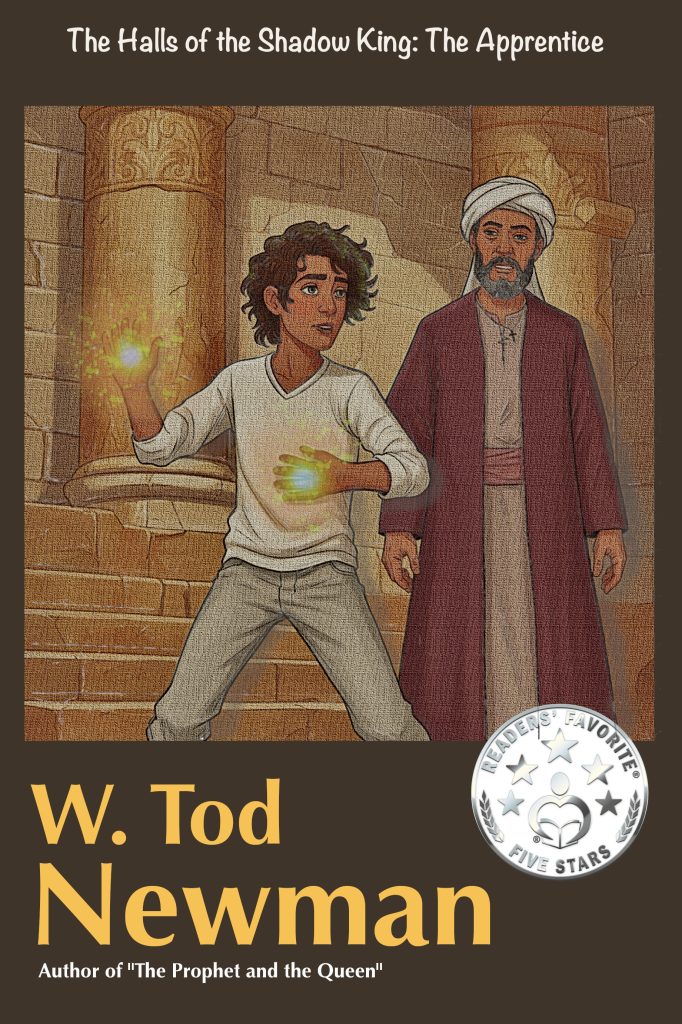
The Halls of the Shadow King: The Apprentice book cover. Copyright 2025 Desdichado Books
Here’s the review I gave my own book on Goodreads. I thought anyone stumbling across this blog might find it interesting and amusing to see an author reviewing their own book! 🙂
Also, funny note. Because I did a pretty poor job on my main character’s right hand in my first book cover, someone accused me of using AI. This bothered me, so I went into GIMP (my image editing tool) and edited the line art layer to make the hands better (apparently AI still can’t do hands?). And then I fixed some other stuff that had been annoying me (too dark, didn’t like the clothes Amal was wearing, background was a bit too formal, etc.). So now the new, improved book cover is loaded here. Let me know what you think.
I really enjoyed reading this book, but maybe that’s because I also enjoyed writing it! For anyone who is considering taking the time to read it, here are a few of the things I was thinking over the last number of years that I spent writing. (of course, I’m giving it 5 stars; if I felt otherwise I’d still be writing!)
After spending several years crafting this story, I’m deeply grateful it found its way into the world—and honestly surprised by how much I enjoyed revisiting Amal’s journey as a reader rather than writer. If you’re considering this book, let me share what drove me through those long nights of research and revision.
Our culture desperately needs more characters who wield great power with genuine humility. It’s perhaps the rarest combination in literature—and life—yet through faithful effort, it remains possible. Amal represents my small attempt to show that extraordinary gifts need not corrupt when carried by someone who truly doesn’t want them and is driven by the service of others.
I also long to see readers rediscover the magic hidden in life’s unexplainable mysteries. We’ve spent decades drowning in stifling rationalism, forgetting that wonder exists in the spaces between what we know and what we can prove. Gabriel García Márquez was the master of this delicate balance—if my words can someday kindle even a fraction of the awe his prose once gave me, I’ll consider this endeavor worthwhile.
Most importantly, I hope to bring history alive in ways that point toward something higher than much contemporary literature attempts. The third century was brutal, beautiful, and utterly transformative—a time when ordinary people faced extraordinary choices that echo through our world today.
If this resonates with you, please join Amal’s journey. I’ve tried to keep the price accessible because stories should build bridges, not barriers. Stick with me, because the next two books will show how determined people, aligned with service and grace, really can change the world—one hard-fought and seemingly-impossible choice at a time.