


Understanding the economic landscape of communities across America has never been more important—or more accessible. At Santa Cruz River Analytics, we’ve developed a powerful Python tool that seamlessly combines U.S. Census Bureau demographic data with Bureau of Labor Statistics economic indicators to provide granular insights into any census tract in the United States.

While national and state-level economic data gets most of the attention, the real story often lies in the neighborhood-level details. Our comprehensive analysis tool bridges the gap between broad economic trends and local community realities by integrating multiple government data sources into a single, coherent analytical framework.
What makes this tool unique?
Our tool pulls from multiple authoritative government data sources:
The system automatically calculates sophisticated economic indicators including:
Generate publication-ready maps and charts that clearly communicate complex economic relationships:


This tool has proven invaluable for various stakeholders:
Economic Development Professionals can identify underinvestment opportunities and track the impact of development initiatives across specific geographic areas.
Policy Researchers gain access to granular data needed for evidence-based policy recommendations and impact assessments.
Community Organizations can better understand the economic challenges and opportunities within their service areas.
Business Analysts can make informed location decisions based on comprehensive local economic profiles.
In our recent analysis of Arizona counties including Pima, Maricopa, Cochise, Graham, Gila, and Pinal, we demonstrated the tool’s ability to:
At Santa Cruz River Analytics, we believe that high-quality government data should be accessible and actionable. Our approach to geographic economic analysis combines:
We’ve built our reputation on transforming complex government datasets into clear, actionable insights that drive better decision-making at the community level.
Our census tract economic analysis tool requires only basic geographic information to generate comprehensive economic profiles:
From these simple inputs, the tool automatically:
The intersection of government data availability and analytical capabilities continues to expand. At Santa Cruz River Analytics, we’re constantly developing new ways to extract meaningful insights from public datasets, helping communities, organizations, and businesses make data-driven decisions about economic development and resource allocation.
Whether you’re working on community development initiatives, conducting academic research, or making business location decisions, having access to comprehensive, tract-level economic data can transform your analytical capabilities.
Interested in learning more about how Santa Cruz River Analytics can help with your geographic data analysis needs? Just leave a comment below! Our team specializes in transforming complex government datasets into actionable insights for economic development, policy research, and community planning initiatives.
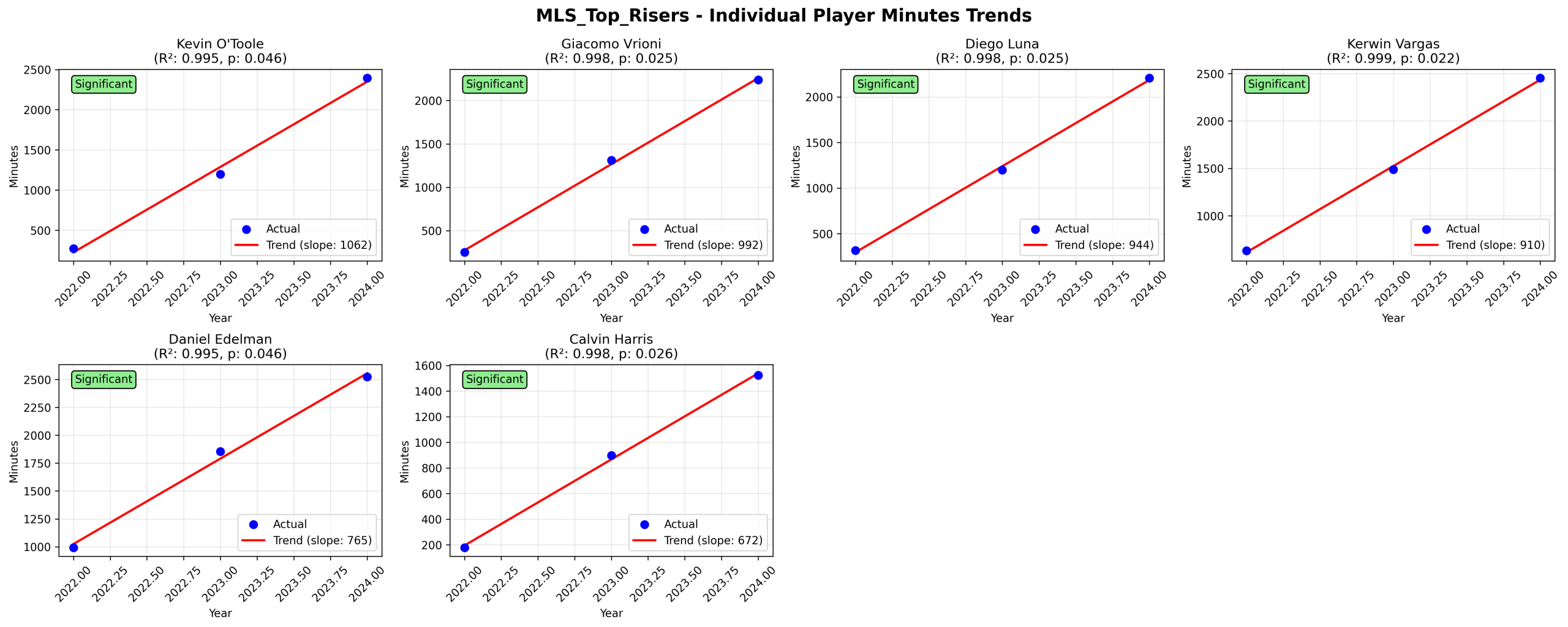
Where consistent growth meets predictable decline in soccer’s most balanced league


While MLS showed remarkable balance in our league-wide analysis, the individual player stories reveal something even more fascinating: Unlike the English Premier League, MLS creates an environment where both breakthrough and decline follow predictable patterns. Here are the standout developmental trajectories from our data. This follows our broad analysis of EPL and MLS playing time minutes… what can this data point measured over time tell us?
MLS players show consistently higher R² values (0.995-1.000) compared to Premier League counterparts, indicating:
Unlike the Premier League’s decline-heavy environment:
These individual stories confirm our league-wide analysis: MLS has created a development-friendly ecosystem where:
Unlike the Premier League’s “survival of the fittest” chaos, MLS demonstrates that constrained economics can actually create better player development environments.
While Premier League individual trends were notable for being rare exceptions to chaos, MLS trends represent systematic approaches to player development.
The Kevin O’Tooles and Daniel Edelmans aren’t beating impossible odds—they’re benefiting from a league structure designed to nurture talent growth. Similarly, the declining veterans aren’t victims of random rotation—they’re experiencing planned transitions.
This is what balanced opportunity looks like in practice: predictable development curves that allow players to maximize their potential within a sustainable ecosystem.
These contrasting development stories reveal why league structure matters more than prestige for individual career growth.
Other Entries in the Playing Time Series
Individual player stories that beat the odds in soccer’s most chaotic league
While our broader analysis (LINK) showed that Premier League careers are notoriously unpredictable, some players have managed to establish clear, statistically significant trends that cut through the chaos. Here are the standout stories from our individual player analysis. Note that these have high R-squared scores and low p-values, meaning their trends are statistically significant… these trends are likely not random chance.


All these players have R² values above 0.9, meaning their trends are incredibly reliable despite the Premier League’s notorious unpredictability. This makes them statistical outliers in a league where most changes are random.
Several players show R² values of 0.998-1.000, indicating perfectly linear career progressions. This is remarkable in a league where rotation, injuries, and tactical changes usually create noise.
While our league-wide analysis showed that Premier League careers are largely unpredictable, these individual cases prove that significant trends can cut through the noise. The key is identifying players with:
In a league where most players face declining opportunities, finding the rare Lucas Dignes and Boubakary Soumarés—players with statistically validated upward trajectories—represents genuine analytical gold.
These individual stories remind us that behind every data point is a human career, and sometimes those careers follow patterns clear enough to predict, even in soccer’s most unpredictable league.
Also see: Experiment High-Level Results and Detailed Analysis of Playing Time Analytics
Next: MLS player spotlights showing how different league structures create different types of breakthrough stories.
Blog Posts in the Playing Time Analytics Series:
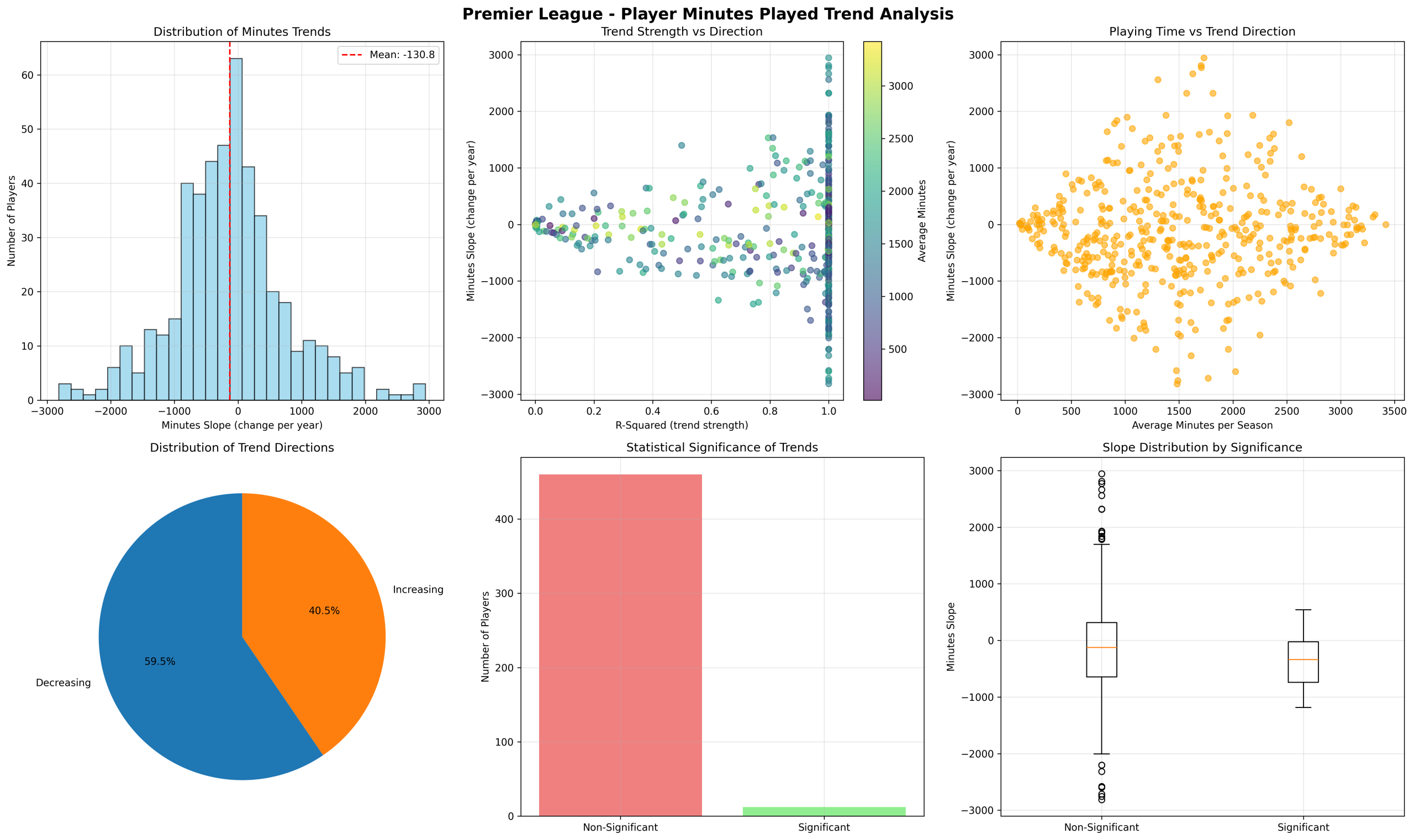
In our previous analysis, we discovered that MLS offers more stable career opportunities than the Premier League despite being considered a “lower-tier” league. But how exactly did we reach this conclusion? Let’s walk through each visualization in our trend analysis dashboard and highlight what makes these leagues so fundamentally different.


The Foundation: Where Every Player’s Story Begins
This histogram shows how many players are gaining or losing minutes each year across the entire league. Note that these bars describe a CHANGE in playing time over the years of the study.
Premier League: Sharp peak of change in playing time around -130 minutes/year with a mean of -130.8
MLS: Perfectly centered around zero with a mean change in playing time of just -4.0
Key Insight: The Premier League actively pushes most players toward fewer minutes, while MLS maintains equilibrium. We discussed some possible reasons for (and consequences of) this in our previous post.
The Reliability Test: Which Trends Can We Trust?
This scatter plot maps trend direction (x-axis) against statistical reliability (y-axis), with color showing average playing time. We use the metric R-squared to describe how our linear regression line “fits” the actual data. A R-squared of 1 means the regression line perfectly describes the data.
Premier League: Scattered, chaotic pattern with few high R-squared values
MLS: More structured patterns with slightly higher R-squared clustering
Key Insight: MLS player trajectories are more predictable, while Premier League careers are subject to more randomness. Check our previous post for fuller analysis of why this might be happening and what it might mean.
The Democracy Test: Do Stars Get Special Treatment?
This scatter plot reveals whether high-minute players (established stars) have different trend patterns than bench players.
Both Leagues: Remarkably similar scatter patterns between MLS and EPL.
Key Insight: Both leagues show “democratic” opportunity distribution—your current status doesn’t guarantee your future trajectory, but the more minutes you play, after a point, the less likely you’ll see a large change in your playing time.
The Balance Sheet: Winners vs Losers
Simple pie charts showing the percentage of players with increasing vs decreasing minutes.
Premier League: 59.5% Decreasing vs 40.5% Increasing
MLS: 50.5% Decreasing vs 49.5% Increasing
Key Insight: This single chart captures the fundamental philosophical difference between the leagues.
The Reality Check: How Much Is Just Noise?
Bar charts showing how many trends are statistically significant versus random variation.
Premier League: ~95% non-significant trends
MLS: ~90% non-significant trends
Key Insight: Both leagues have unpredictable elements, but Premier League chaos makes career planning nearly impossible.
The Magnitude Question: Are Real Trends Bigger Than Random Ones?
Box plots comparing the size of statistically significant trends versus random variation.
Premier League: Similar box sizes between significant and non-significant
MLS: Slightly wider “significant” box
Key Insight: MLS rewards patience—real trends are more distinguishable from noise.
The charts paint a picture of a league where:
The visualizations reveal a league where:
You can see the Premier League’s financial pressure in every visualization:
The salary cap and roster rules manifest as:
For Players: Use these charts to understand which league environment suits your career stage and goals.
For Analysts: The significance rates tell you which trends to trust for predictions.
For Fans: These patterns explain why your favorite player’s role might be more stable in MLS than you’d expect.
Six simple charts reveal a profound truth: league structure fundamentally shapes individual careers. The Premier League’s unlimited resources create chaos, while MLS’s constraints foster stability.
Sometimes the most important insights come not from complex algorithms, but from carefully visualizing the simple question: “Are players generally getting more or fewer opportunities over time?”
The answer, as these charts clearly show, depends entirely on which side of the Atlantic you’re playing.
Next up: Individual player spotlights showing which specific players are beating the odds in each league’s unique environment.
Blog Posts in the Playing Time Analytics Series:
When we think about the differences between the English Premier League and Major League Soccer, we usually focus on the obvious: prestige, talent level, global reach. But what if I told you that the most revealing differences lie hidden in something as simple as playing time trends?
Using advanced statistical analysis of player minutes over multiple seasons, I uncovered some interesting patterns that hint at the fundamental DNA of these two leagues. The results are more fascinating—and counterintuitive—than you might expect.
After analyzing thousands of players across both leagues from 2022-2024, the data tells a clear story:
Here’s the counterintuitive finding: MLS, despite being a “lower-tier” league, actually offers more stable career opportunities than the world’s most prestigious soccer competition.
In the Premier League, money and prestige creates chaos. With transfer budgets exceeding $200 million and relegation costs around the same figure, clubs operate in constant panic mode (Man U, looking at you). The result? A “disposable player” mentality where:
All of these disruptive factors can be observed in the playing time trends across seasons
MLS’s salary cap ($5 million per team) and unique roster rules create an entirely different dynamic. Yes, there are negatives, but there are also some positives regarding player development:
If you can survive the craziness of Premier League rotation and competition, you’re likely exceptional. But the data shows most players experience declining opportunities over time. It’s a league that chews up talent and spits it out. Even the best players can struggle to find a fit on a high-performing EPL team.
MLS offers something increasingly rare in modern soccer: time to develop. Players get longer leashes, more consistent opportunities, and genuine chances for comeback stories. MLS Next Pro is now standing up as a developmental league and the USL Academy is also ramping up development of players who might be expected to play in the USL or MLS.
This analysis reveals a profound truth about modern soccer: financial inequality doesn’t just affect competitive balance—it fundamentally alters how players’ careers unfold.
Young Players: Might be best off to consider MLS for development opportunities, even if it means lower initial prestige
Fantasy Soccer Players: Premier League minutes are nearly impossible to predict; MLS offers more reliable patterns. Perhaps this is meaningful or not, but playing fantasy at a high level means understanding what about the sport is predictable and what is not.
Talent Evaluators: Players succeeding in Premier League’s chaos demonstrate exceptional adaptability. EPL teams in general are using these kinds of analytics to evaluate upcoming players who have survived the meat grinder.
League Administrators: Salary caps and roster rules can actually improve player development environments. Not sure if the MLS cares about this as much as the rules’ influence on the bottom line, but I find it interesting.
The trend analysis used linear regression to track each player’s minutes change over time, revealing:
As soccer becomes increasingly globalized and commercialized, these findings suggest we might need to reconsider our assumptions about league quality and player development.
The Premier League model—unlimited spending, constant roster turnover, high-pressure environment—may be great for spectacle but potentially problematic for sustainable player development.
The MLS model—constrained spending, forced player development, balanced opportunities—might offer lessons for other leagues seeking to optimize talent cultivation.
While the Premier League will always attract the world’s best talent through prestige and wages, this analysis shows that more money doesn’t automatically mean better opportunities for most players.
MLS, with its salary caps and development focus, has accidentally created something valuable: a league structure that gives players genuine chances to grow, adapt, and succeed over time.
In an era of increasing player burnout and shortened careers, perhaps there’s wisdom in the MLS approach. Sometimes, constraints breed opportunity.
This analysis was conducted using data from FBRef.com, followed by statistical trend analysis across multiple seasons.
Want to dive deeper? The complete dataset and visualizations reveal even more fascinating patterns about age, position, and team-specific trends that continue to challenge conventional wisdom about player development in modern soccer.
Blog Posts in the Playing Time Analytics Series: