
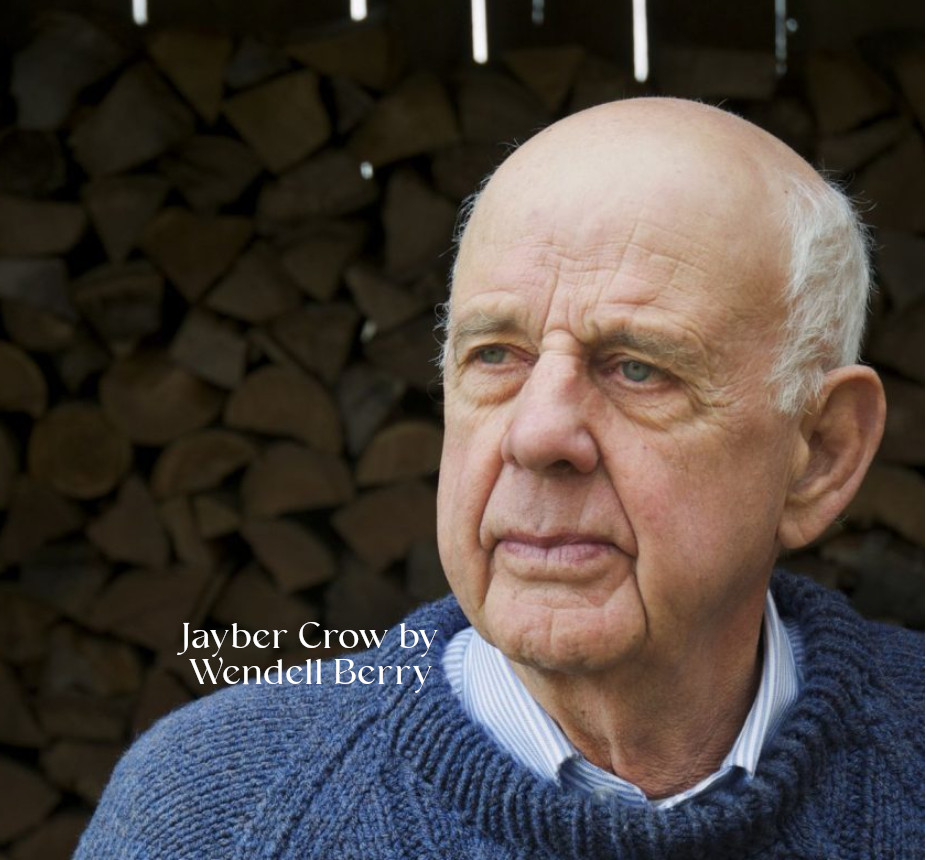
Reflection by the Reviewer
For most of my adult life, the stories and essays of Wendell Berry have been something close to a guiding light—not in an uncomplicated way, but in the way a good teacher unsettles you as much as he reassures you. Berry’s fiction has informed how I think about home, about whether and how to return to it, and even gave me the name for a daughter. I first read Jayber Crow around the year 2000, at an age when I understood the longing for an ancestral home. It struck me at a moment when I was considering whether it was possible to return to the old home place myself. That timing shapes how I read the book then, and it colors how I read it now. Whether it has a similar power for a reader without that particular urge is a fair question, and one I’ll come back to.
The Basics about Jayber Crow
The novel follows its namesake, the orphaned Jonah Crow, through an orphanage school, a stint at Bible college, and an unfocused period at university—none of which take, until he’s overtaken by the urge to return to a place he barely remembers. Flood and near-hypothermia deliver him, more by accident than design, to the newly abandoned barber shop in Port William, not far from where he lived as a boy with his parents and, later, his aunt.
As the town’s new barber, he’s renamed Jayber—for reasons only a small, self-regarding town would arrive at—and becomes the quiet confidant of its stories, tragedies, and small triumphs. He meets Mattie Keith when she’s a schoolgirl and he’s barely older, and she becomes the one-sided, lifelong love of his life. The tales he retells—pride in work done right, connection across generations, the ordinary failure to live up to what we owe each other—are the raw material of what Berry calls the “membership” of Port William.
The Membership of Port William
What is a “membership”? Berry’s own description is the best one available: it’s a community “held together by frayed bonds of affection, mutual forgiveness, and a persistent will toward goodwill despite human failure.” It may be one of the more quietly radical ideas across his essays and novels—a concept that feels mostly lost, and that the book makes you want to see regained. But Berry is careful never to make it sound easy. It arrives, when it arrives at all, only through the kind of deliberate, unglamorous attention the quote above describes.
The Protest of Unnatural Structure
One of my favorite passages in the novel comes from Jayber, failed Bible-school student and reluctant philosopher, on faith and institution:
“I am, maybe, the ultimate Protestant, the man at the end of the Protestant road, for as I have read the Gospels over the years, the belief has grown in me that Christ did not come to found an organized religion but came instead to found an unorganized one. He seems to have come to carry religion out of the temples into the fields and sheep pastures, onto the roadsides and the banks of rivers, into the houses of sinners and publicans, into the town and the wilderness, toward the membership of all that is here.”
Berry returns to this idea often in his essays: that people build their identity around organization and structure instead of around the people actually in front of them, and that much of what ails a community traces back to that misdirection. In Jayber Crow, the clearest case study is Troy Chatham—talented, popular, and determined to become a big man by adopting the agribusiness model rather than the land-stewardship his father-in-law, Athey Keith, had practiced his whole life. Athey works to give his family and hired hands just a little more than they need; Troy chases scale and margin, buys the machinery, takes the advice of the big names, and builds the structures he thinks will finally let him break through. He has no real concern for the people involved, and the book doesn’t let him off the hook for it.
Comparisons in Modern Literature
I consider Berry largely without close comparisons, but one beloved book comes to mind after some thought. Marilynne Robinson’s Gilead in some ways mirrors the shape of this book in both story and emotion, even though the two authors rarely get shelved together. Both novels hand the whole story to an old man looking back—an Iowa preacher in Robinson’s case, a Kentucky barber turned lay theologian in Berry’s—and both use that retrospective voice masterfully to blur the line between memoir and sermon. Where they part ways is in scale and temperature. Pastor Ames’s Gilead is a town seen almost entirely through one household’s inheritance and one dying man’s reckoning with his own faith; Jayber’s Port William is wider and cooler-eyed, closer to a communal biography than a personal confession, more interested in what a whole membership owes each other than in what one man owes God. Put the two side by side and Berry’s book reads less like a novel about faith and more like a novel about the practice of belonging—which is, I think, exactly the distinction Jayber himself is drawing in the Protestant-road passage above.
Ultimately, It’s About Love
Jayber sees plainly the need for, and the cost of, love in holding a community together—the same love Athey Keith practices in his rejection of self-interest and his devotion to the land and the people on it. Jayber recognizes this early, and returns to it often, as here:
“But love, sooner or later, forces us out of time… of all that we feel and do, all the virtues and all the sins, love alone crowds us at last over the edge of the world. For love is always more than a little strange here… It is in the world, but is not altogether of it. It is of eternity. It takes us there when it most holds us here.”
Jayber comes to understand that this love is unnatural—even necessary—for holding a community together. Life is his teacher, but he never takes the lesson for granted; he stays inside the mystery of it rather than resolving it:
“For love is always more than a little strange here. It is not explainable or even justifiable. It is itself the justifier. We do not make it. If it did not happen to us, we could not imagine it.”
Closing Thoughts
Jayber Crow is not a fast book, and it isn’t trying to be—its patience is the point. Where it’s most vulnerable is in that same patience: Berry trusts the accretion of small-town anecdote to carry the theology, and I could imagine that readers who want more forward motion in the back half may struggle with the waiting. But for anyone who has ever weighed staying against leaving, or wondered what’s actually owed to the people and the ground you came from, this is one of the clearest answers American fiction has given. It teaches us that the waiting is an important part of the process and it belongs on the same shelf as Gilead—and deserves to be read as closely.
Other Links of Interest:
BOOK REVIEWS by Tod Newman
POSTS ABOUT SELF PUBLISHING by Tod Newman
SHOP for the Novels of W. Tod Newman