
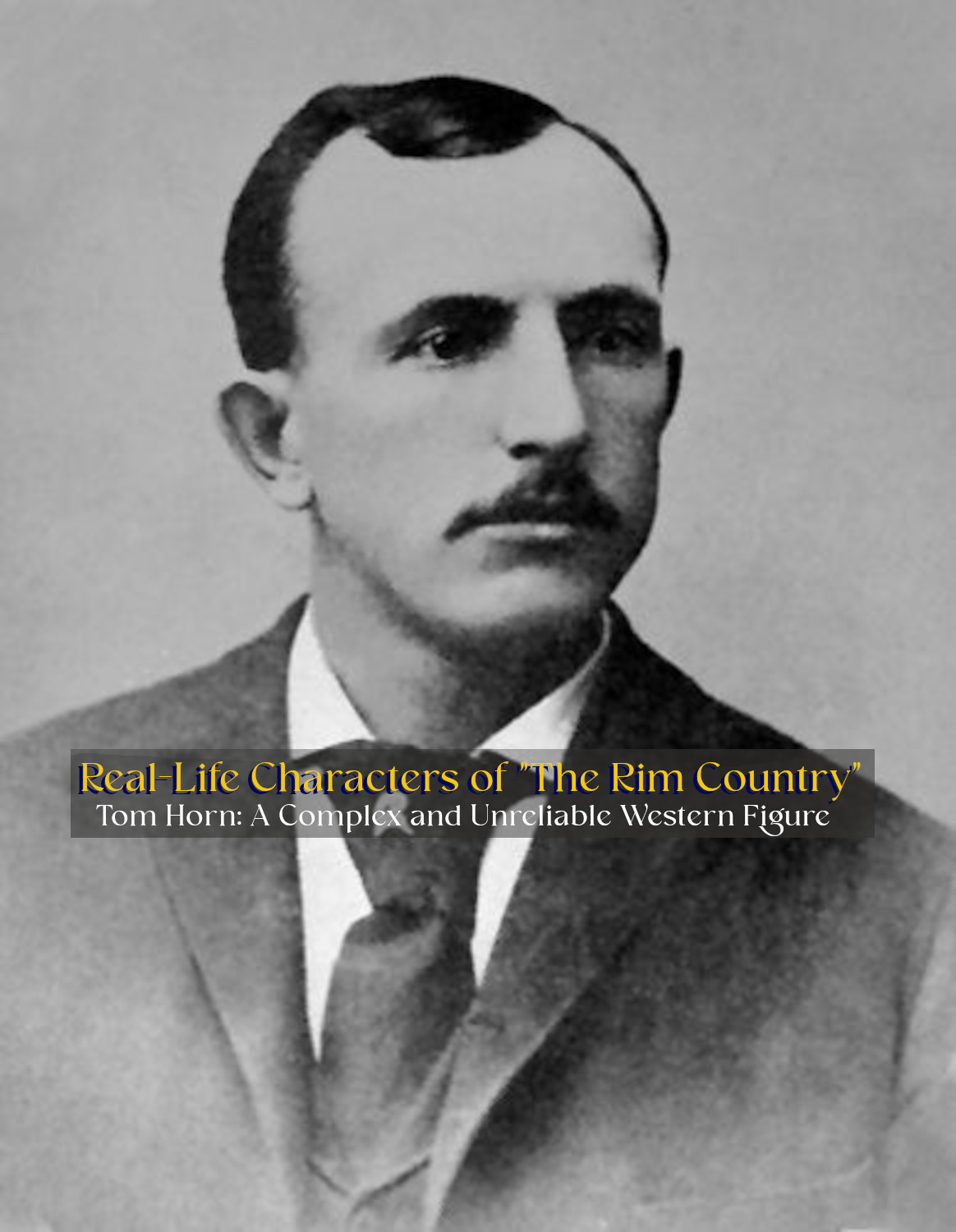
Readers who know their Old West history will recognize the name the moment he rides into the story. Tom Horn—real cavalry scout, Pinkerton man, and, eventually, the hired gun hanged in Wyoming in 1903 for the murder of a fourteen-year-old boy—makes an appearance in The Rim Country, and it’s worth separating what’s documented from what’s invented before saying how the novel puts him to use.
What we actually know about Horn
Tom Horn was a middle child: fifth of twelve, perhaps always looking to capture attention. It seems that much of his life involved his pursuing adrenaline-tingling opportunities and then eventually overstating them in his autobiography. He did not have nearly as large of a role in the pursuit of Geronimo as he claimed; probably he was just attached to the Army column that was eventually successful. He did not participate in the Battle of Cibecue Creek as he alleged. This has been debunked by historians. Overstatement of his skills got him hired by Pinkerton, where he arrested a few outlaws—right before he was arrested himself for robbing a New Mexico casino.
The historical Horn was definitely in Arizona Territory—the setting of “The Rim Country”—in the early-to-mid 1880s, working as an army scout and interpreter. He had a hand in the campaigns against Geronimo and was present for the surrender in 1886. By the 1890s he’d remade himself as a “stock detective” for Wyoming’s big cattle interests, a euphemism that meant intimidating and, when the money called for it, killing suspected rustlers. His participation in he Pleasant Valley War, which ran roughly 1887–1892 in the Tonto Basin, is lightly documented and partially legendary: he was in the vicinity and his resume shows a blank for those years, he was known to be connected with Ed Tewksbury, there is evidence he was deputized by various lawmen in the area, and he was the right kind of man. There are reasons to believe the stories of his involvement, but remember that The Rim Country is extrapolating, not reporting.
What the novel does with that gap
That’s the honest frame for how Horn functions in the book: he’s a plausible, legendary ghost slotted into a real conflict, hired—in this telling—by multiple different parties who need a man with no conscience and a fastidious dedication to his employers’ requirements. In the book, he doesn’t take a side in the Graham–Tewksbury feud itself. He’s there to survey the terrain, read the cattlemen, and price out how much violence it will take to move accomplish powerful people’s goals.
The more interesting choice is formal rather than factual. Nora Callahan, the novel’s central sensitive, can read intention and conscience in the people around her—except in Horn. He registers to her gift as an absence, not a color on the spectrum of good and bad men. That blankness becomes the novel’s way of characterizing him without narrating a backstory: rather than explaining what made Horn what he was, the book lets a reader feel the specific chill of a man who has simply removed himself from the moral register altogether, and lets that stand as its own kind of history—the kind that doesn’t survive in an archive but was very likely true of somebody in that valley in those years, whether or not it was true of Horn precisely.
It’s a case for how historical fiction can be honest about its own liberties: naming a real man with a legend of involvement, borrowing his known reputation, and then openly building fiction into the years the record doesn’t cover.
Other Links of Interest:
BOOK REVIEWS by Tod Newman
POSTS ABOUT SELF PUBLISHING by Tod Newman
VIDEO discussing the Series
BUY The Rim Country: Book One “The Invitation” by W. Tod Newman.
THOUGHTS on the dysfunction of the Old West