
Book One of my new series “The Halls of the Shadow King” is now up on Amazon. I’ve been working on it since 2016, on and off.
Yes, I got a little distracted!
Book One of my new series “The Halls of the Shadow King” is now up on Amazon. I’ve been working on it since 2016, on and off.
Yes, I got a little distracted!

Have you ever wondered what it was really like to walk the dusty streets of ancient Jerusalem as the Babylonian army approached? My journey to answer this question led me to years of research and a novel that brings the biblical prophet Jeremiah to life in vivid detail. Check out my YouTube video series where I describe this whole process.
Recreating the world of ancient Judah, Babylon, and Egypt required meticulous research. I dove into archaeological journals, studied ancient Near Eastern customs, and examined contemporaneous texts to ensure historical accuracy. One fascinating discovery was how the political dynamics between Egypt and Babylon created a deadly vice that squeezed the small kingdom of Judah—a tension that directly shaped Jeremiah’s prophetic ministry.
The biblical Jeremiah can seem distant across the millennia, but he was a man with hopes, fears, and doubts. In my novel, I explored the human side of this reluctant prophet—his internal conflicts as he delivered unpopular messages, his loneliness, and his unwavering faith despite persecution. By developing complex relationships between Jeremiah and both his supporters and opponents, the ancient narrative takes on new emotional depth for modern readers.
Though set 2,600 years ago, Jeremiah’s story touches on themes that resonate powerfully today: speaking truth to power, maintaining integrity in corrupt times, and finding hope amid societal collapse. These timeless elements make this ancient prophet’s journey relevant to contemporary readers, whether they approach the story from a spiritual perspective or simply as lovers of immersive historical fiction.
It’s been several years since my previous novel hit the shelves. Back then, I documented my entire self-publishing process in a comprehensive series that many readers found valuable. I’m pleased to say that following my own advice saved me considerable time and resources with this latest release. If you’re considering publishing your own work, this step-by-step guide remains as relevant as ever.
Ready to immerse yourself in the tumultuous final days of the Kingdom of Judah? Whether you’re a history enthusiast, spiritual seeker, or simply enjoy character-driven historical fiction, my novel offers a window into one of history’s most pivotal periods through the eyes of an extraordinary prophet.
Get Your Copy Today! – Available in e-book and paperback on Amazon
What aspect of ancient history or biblical narratives would you like to see explored in future novels? Share your thoughts in the comments below!
If you want to be added to our newsletter (no worries, we won’t overwhelm you), we often create bonus material only for newsletter subscribers. Just sign up with your email address below.
Check out the six part series on the creative elements behind “The Prophet and the Queen”. Find the whole playlist here on YouTube! Each video is somewhere between 5-10 minutes, so they don’t require a huge investment! 🙂
Join author W. Tod Newman as he takes you behind the scenes of his acclaimed historical novel “The Prophet and the Queen.” In this six-part series, Newman reveals the creative process, historical research, and literary decisions that brought the world of ancient Judah, Babylon, and Egypt to life. Discover how he humanized the biblical prophet Jeremiah, crafted complex relationships between characters, and wove historical events into a compelling narrative. Whether you’re a history enthusiast, spiritual seeker, or lover of literary fiction, these insights will enrich your reading experience and illuminate the timeless themes that make this ancient story resonate with modern readers.
It has been a few years since my previous novel was released. At the time I did a long series on self publishing (find it here). I found that the series was helpful to me even in this latest effort.
Check out the new novel over at Amazon (e-book or paperback) or Lulu (paperback).
If you want to be added to our newsletter (no worries, we won’t overwhelm you), we often create bonus material only for newsletter subscribers. Just sign up with your email address below.

For those who are arriving here after downloading my most recent novel, I have a question…
How interested would you be in my trying to publish a novel serially (like a new chapter per week)? I have tried this in the past, but it seems like people didn’t make it to the site or didn’t find it compelling.
Leave me a comment with your thoughts… I’d love to be able to revive the notion of serially published stories, but wondering if that era will never happen again in the modern era.
Thanks!!
It has been a few years since my last novel was released. At the time I did a long series on self publishing (find it here). I found that the series was helpful to me even in this latest effort.
Check out the new novel over at Amazon (e-book or paperback) or Lulu (paperback). The free e-book promotion has finished, but we saw nearly 1K downloads, which placed the book at #1 on Amazon Kindle for a couple of days. Just a couple of days, of course.
I asked claude.ai to build a promotion less than 350 words for this book and this is what it gave me. Not bad!
A biblical epic of faith, power, and prophecy in the ancient world
Journey to the tumultuous world of the ancient Near East in this gripping reimagining of the prophet Jeremiah’s extraordinary life. As empires clash and Jerusalem faces destruction, one reluctant prophet stands at the crossroads of history, torn between divine calling and human frailty.
Jeremiah never wanted to be The God’s voice. Yet as Babylon’s armies threaten everything he loves, he finds himself caught in a dangerous spiritual battle against the seductive Queen of Heaven who tempts his people away from their faith. From the mud-filled cistern where his enemies left him to die to the courts of Pharaoh himself, Jeremiah’s journey reveals the high cost of speaking truth to power.
With rich historical detail and psychological depth, “The Prophet and the Queen” explores:
Perfect for readers of Francine Rivers, Geraldine Brooks, and Tessa Afshar, this meticulously researched novel brings biblical history to vivid life while exploring questions of faith, purpose, and personal integrity that resonate across millennia.
“A mesmerizing tale that humanizes one of the Bible’s most enigmatic prophets while illuminating the turbulent world he inhabited. Readers will be swept away by this powerful reimagining of ancient events that shaped religious history.”
If you want to be added to our newsletter (no worries, we won’t overwhelm you), we often create bonus material only for newsletter subscribers. Just sign up with your email address below.

Writing Freely Without Self-Editing
In phase one of editing, you’re still writing! One of the things I’ve learned to avoid is wearing my editor brain while I’m trying to write with my creative brain. I find that often times if I put the editor in the drawer for a while, I develop really unique ways of developing description and dialog. Also, when the creative is in charge, the plot often unfolds in surprising and pleasing directions. My approach is to let the creative side finish the book before the editing brain steps in.
When done…
I usually intentionally give the manuscript a break for a few days. I have found that finishing the writing is exciting and my brain is still mulling things over for days after I finish. I keep my notepad around to capture ideas. I think I’m always aware of the limitations of the manuscript at this point and I suspect my subconscious is still trying to resolve areas of concern. After a week or so, I update the manuscript with the changes that come to me and then I kick into basic editing mode. Running spell-check and grammar-check here is a good practice that will save you time later on. I tend to just use the capabilities built into LyX or even MS Word, but I know there are tools out there like Grammarly that could be helpful. I just don’t usually want to deal with them. I also format the output a few different ways at this point and export PDF files from LyX. I like to see what the book looks like in 9×6 format and I also tend to output a version in 8.5×11. The latter is likely to become the basic for early ebook (epub) formatting. This allows me to do editing on my Kindle later in the process.
Editing Pass One
My practice is to focus on specific areas during different editing passes. During pass one, I have fixed the gross spelling and grammar issues and am interested in making the characters likeable and developing action. These are targeted forays into the manuscript looking for Character Point-of-View, descriptiveness, and dialogue improvements.
Editing Pass Two
My second pass through editing normally involves either reading the work out loud to myself or others or it might involve sending it off to a friend to read for fun. Normally at this stage I mostly find gross errors that I made and didn’t detect during the first pass.
Editing Pass Three

At this point, I generally send an 8.5×11″ formatted PDF file of the book to someplace like OfficeMax to print and bind. This usually costs on the order of $20 but is well worth it. That bound manuscript accompanies me almost everywhere I go for weeks. Having it printed on paper causes me to think about the work differently for some reason. Often during this pass I find places where I’m overusing my “favorite” words and phrases or where I’m using the same words too closely together. In addition, I put effort into eliminating “lazy” words throughout the manuscript. These are words that tend to be passive and they include the classical passive voice (“were eaten”, “is changed”, etc.) but also words that imply passive uncertainty like “he thought”, “they considered”, “it possibly”, etc. I’m not sure if this is a formal rule, but lazy words and phrases tend to be boring. During this phase I also write ideas in the margins, develop more details about the setting and scenes, etc., using this printed manuscript. Once I finish this phase, the book is normally in really good shape.
Editing Pass Four
Often times I will formulate the book into an ePub format using Calibre for the fourth pass. This allows me to have a portable eReader format that I might send around to people to pre-review. It also allows me to complete my editing on my Kindle, which enables yet another unique way of looking at the book. When I find errors, I highlight them on the Kindle and add a note to remind me what I need to fix or improve. At the end of this phase, I just look at the highlights for my book in the Kindle and fix the mistakes in LyX one by one.
Key: Avoid Over-Editing
Often times I have to decide that there’s nothing egregious in my book and though I could improve it, I probably need to stop. Sometimes I realize that my first intuition about how to pen a phrase was the best and I struggle to get back to my first revision! My opinion is that oftentimes when a writer is in the flow of writing, their first intuition might be informed by the System 1 thinking which makes rapid, subconscious decisions. Occasionally System 1 hands off an idea to System 2, which is more rational and deliberate. I think this is a picture of the creating brain (System 1) and the editing brain (System 2). This is the topic of Dr. Danny Kahneman’s book, Thinking, Fast and Slow.

LINKS TO THE SERIES:

In previous entries I have described at some length the process I use to get to the point where I start capturing content into my computer. Now that we’re actively writing, I want to touch on some of the things that I think are important to know about using these tools.
Typesetting
The word typesetting goes back to the early days of the printing press where physical movable type elements were set into place by people known as “compositors” to create a page. One funny piece of trivia about this process is that the compositors were extremely skilled at reading text backwards, for that is how they had to set the type for it to print in the correct direction! There was an element of creativity in typesetting too, for the objective was to create an optimal reading experience for the ultimate consumer of the text. As there were many variables under the control of the compositors to achieve this objective, there was sometimes a type of signature that the individual compositors would leave in the printed text.
Word Processing and Typesetting
This may be a controversial opinion, but in my case it is based on experience. I submit (very respectfully) that Word Processors like Microsoft Word are not really intended to perform typesetting. Word Processors were originally intended to replace the typewriter and thus move the office place into the computer era more smoothly. Today’s Word Processing software is far more capable than the early word processors (which used mono-spaced fonts, just like typewriters) but it is still not a native tool for typesetting. There are templates that can be used inside Word for this purpose, but they seem complicated.
To address the challenges of typesetting on a typewriter (a problem that later sprawled over to the Word Processor), Donald Knuth created the TeX system. This family of typesetting solutions generated a number of related descendant variations such as LaTeX. The TeX system was always difficult to learn, but it earned its place in the world of academia for published papers and became something of a typesetting standard.
TeX with a Human Interface! I use the software tool LyX for not just it’s typesetting capabilities, but also because it has what I consider to be advanced writing capabilities too. Here are some of the reasons I’ve used LyX for all my books:

E-Book Generation
One of the weaknesses of Lyx is that it doesn’t seem to have a clean way to export a text as an epub or other ebook file format. Perhaps this is acceptable to Lyx, however, because the ebook formats aren’t strong on typesetting anyway.
So when I have completed editing of my Lyx document and am ready to create an ebook that I will use to refine the editing on the Kindle, I export from Lyx to html and then import into Calibre. From Calibre I then convert the html file to an epub file which I then simply email to my Kindle. One of the few things I do inside the Calibre tool before conversion is to load my cover art (if it is ready). Then the converted epub document will have my cover art attached.
The epub format is convenient as well if you wish to send your work around to select others for editing and evaluation. This is because pdf files are hard to read (for me at least) on the phone or computer and pdf files don’t load nicely into the Kindle. The epub file, however, is much easier to read on the Kindle and works exactly like an ebook that you purchase (text size can be increased decreased, etc.).
Artwork
I have used the free image editing tool, GIMP, for many years, so when I’m writing a book, I tend to want to do my own illustrations. GIMP is very similar to Photoshop in the way it works. My process is fairly simple.
Cover Art Buildup Example


LINKS TO THE SERIES:

This blog entry is a bit of a deviation from my plan because in the last entry on the writing process, I discussed the act of “emerging” characters and felt that I needed to go deeper into my thoughts on this important process. So we’ll start with how Hollywood (and many others) think about emerging their leading characters.
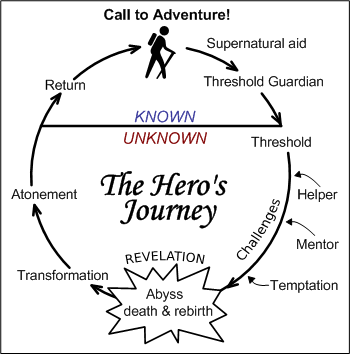
The Hero’s Journey
The Hero’s Journey is a well-worn strategy to developing a character’s emergence throughout the narrative of a story or (especially) a movie. It has been well-described by mythologist Joseph Campbell in his book The Hero with a Thousand Faces, and time has made it very clear that it can be a very convenient pattern for many authors and screenwriters because it is attractive to consumers and inspirational. And… it is easy to disguise so people don’t get sick of it. See the graphic below. Perhaps some lives follow this cycle of growth, but my thought is that perhaps not so many as we would imagine. We know the life of Luke Skywalker and Harry Potter follow this exact journey, because George Lucas admitted as such and in places it appears that JK Rowling used it as a template. But do normal characters’ lives follow this approach, and if not, is strict adherence to the Hero’s Journey going to make your characters “exciting but not real”?
Making Characters Real AND Interesting?
Here are a few of my concerns with over-reliance on the Hero’s Journey in literature.
An Example of REAL Character Emergence
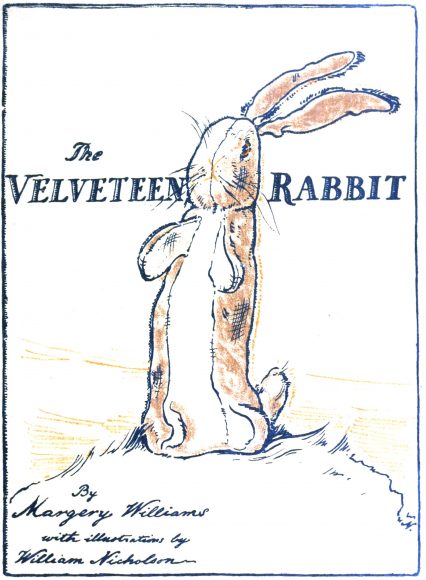
In The Velveteen Rabbit, we see Margery Williams emerging her characters, toys that have a desire to become REAL in loving and careful ways. What she does not do is hide the growth process under that gloss of the Hero’s Journey. She shows the struggles and disillusionment and the sadness than co-exist with a character’s true journey, as opposed to their idealistic journey. Getting to REAL in The Velveteen Rabbit is costly. So it is in the real world too. Hank Williams put it well in his frequently-covered song, “No matter how I struggle and strive / I’ll never get out of this world alive”
From The Velveteen Rabbit
“Real isn’t how you are made,” said the Skin Horse. “It’s a thing that happens to you. When a child loves you for a long, long time, not just to play with, but REALLY loves you, then you become Real.”
“Does it hurt?” asked the Rabbit.
“Sometimes,” said the Skin Horse, for he was always truthful. “When you are Real you don’t mind being hurt.”
“Does it happen all at once, like being wound up,” he asked, “or bit by bit?”
“It doesn’t happen all at once,” said the Skin Horse. “You become. It takes a long time. That’s why it doesn’t happen often to people who break easily, or have sharp edges, or who have to be carefully kept. Generally, by the time you are Real, most of your hair has been loved off, and your eyes drop out and you get loose in the joints and very shabby. But these things don’t matter at all, because once you are Real you can’t be ugly, except to people who don’t understand.” – Margery Williams’ “The Velveteen Rabbit”
LINKS TO THE SERIES:

My goal in this episode of the Self-Publishing series is to touch on both the physical and mental aspects of the actual writing process. Perhaps some of this is taught in creative writing workshops, but other elements are just best practices I’ve stumbled upon.
As I’ve mentioned in previous entries, I try to delay the actual no-kidding writing process as long as I can because my belief is that once I’ve started typing much of the creative decisions I need to make with the work are in the past. In the non-literary world of creative problem solving we often talk about diverging then converging. In my experience, once I’m writing on the computer, I’m in converging mode. Or if I’m not, I need to be or I’ll never finish.
So here are some of my thoughts about this process of converging onto a publishable work:
LINKS TO THE SERIES:

